Guide
Active recall, done consistently: the habit that holds
Active recall means closing the book and pulling the answer out of your own head. It beats rereading at every delay longer than a few minutes, it feels worse while it works better, and the part most people get wrong is not the recall but the "consistently". A short slot most days, with a missed day costing nothing, is what holds.
In short
- Testing yourself beats rereading for anything you need next week, not just tomorrow.
- It feels worse because it is harder, and the difficulty is the point.
- Three correct recalls when you learn a thing, then three spaced relearnings, is the researched dose.
- Attach the habit to a slot, keep it short, and decide in advance that a missed day costs nothing.
- A flashcard app with spaced repetition turns the dose into a daily session you don't have to plan.
What is active recall, and why does it beat rereading?
Active recall is answering a question from memory before you look: a flashcard, a blank page, a practice question. Rereading is looking again. The difference sounds small and the results are not.
The study that made the point for a generation is Roediger and Karpicke's in 2006. Students read prose passages, then either took free-recall tests on them without feedback or reread them the same number of times. Five minutes later, the rereaders did better. That is the trap: the immediate result favours rereading. At the longer delays the authors tested, the students who had tested themselves retained more, and the paper's conclusion is that testing is a powerful way of improving learning, not only of measuring it.
It holds for understanding, not just for facts. Karpicke and Blunt showed in 2011, in Science, that retrieval practice produced more learning than elaborative studying with concept maps on science texts, including on questions that needed inference, and even when the final test was itself a concept map. A meta-analysis by Adesope, Trevisan and Sundararajan in 2017 pooled the practice-testing literature and found practice tests more beneficial than restudying and than every other comparison condition in it. And when Dunlosky and colleagues rated ten study techniques in 2013, practice testing and spaced practice were the two rated high utility, while rereading and highlighting, the two students use most, were rated low.
Takeaway
Read a thing once to understand it. After that, every pass should be a recall, not a reread.
Why does it feel worse while it works better?
Because recall is effortful and rereading is fluent, and fluency feels like knowledge. Kornell's flashcard experiments in 2009 found spacing better than massing for 90% of participants, yet 72% of them believed massing had worked better after their first session. Kornell and Bjork found the same thing in 2008 with paintings: mixing artists' works helped people classify new paintings better than grouping them, yet the grouped study felt more effective. Robert Bjork named the general pattern in 1994: conditions that make practice feel harder and slower, such as spacing, mixing and testing, often produce better performance later, which he called desirable difficulties.
The practical consequence is that you cannot steer by feel. If a session felt smooth, you probably reread. If you struggled to pull answers out and got some wrong, you probably learnt something. Keep a measure instead of a feeling: how many you recalled, and which ones failed.
How much recall is enough?
Enough to get a thing right three times when you learn it, then to meet it again three times, spaced out. That is Rawson and Dunlosky's recommendation from 2011, drawn from three experiments with 533 students learning conceptual material, tested one to four months later. The relearning sessions had a large effect on how much was retained, at a small cost in extra practice. More than that in one sitting adds little; the gaps are what add the rest.
The gaps grow with the horizon. For something you need in a month, the first serious review comes about a week after you learn it; for something you want for years, the gaps stretch to months. Working that out by hand for hundreds of cards is what spaced-repetition software exists for, and it is the one piece of the habit you should not do by hand.
How do you make it a habit that holds?
By attaching it to a slot rather than a counter, keeping it short, and deciding in advance that a missed day costs nothing. We read 230,816 posts, comments and app reviews by people who use flashcard apps, and the people who had kept the habit for years said the same things.
- A slot. "Nowadays I usually do my reviews on the bus on my way to work." The bus, the kettle, the walk: a time or a place, not a streak.
- Small, daily. "The most important step is to just show up. You will falter. Show up again tomorrow." Ten or twenty minutes most days beats an hour twice a week, because the gaps between reviews are what make recall work.
- A missed day is a blank day. Streaks got people going and then took them down with them: "Losing my +1000 days streak tomorrow, say goodbye." If your tool punishes a miss, the miss becomes the reason to quit.
- Stop before you are tired. "Burnout after 1.5 hours of Anki. How to avoid?" By not doing 1.5 hours. A session that ends on a clear finish is one you come back to.
- Don't spend the slot on the tool. "I was spending 30+ minutes a day just MAINTAINING my system before I ever opened a textbook." Defaults, and start.
How does Bunshu do this?
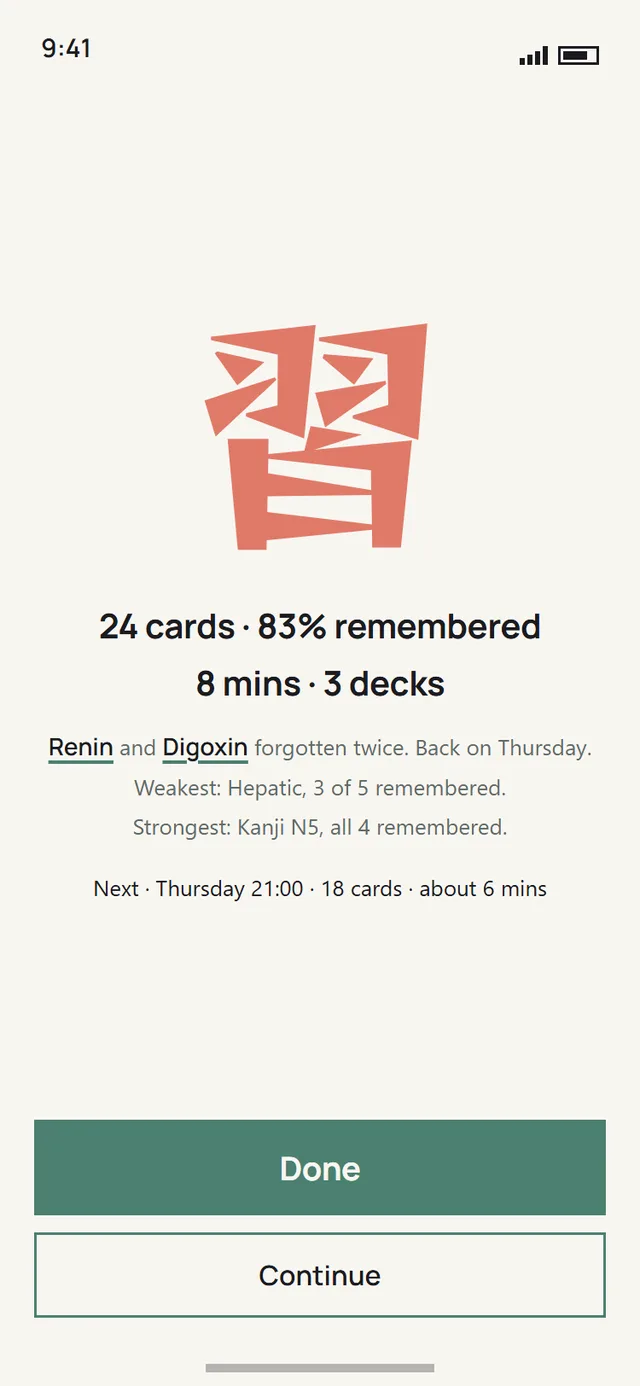
Every card in Bunshu is a recall: a question, a reveal, and four buttons for how it went, or a typed answer with the difference marked. The model (FSRS, the open-source scheduler) brings each card back just before you would forget it, which does the spacing for you, and the session is the cards that fit the minutes you set. The session ends on a stamp with your numbers and the cards to fix, and when your own answers slow down it asks once whether you would like a break. Sessions live in Schedule with a reminder at each; there is no streak, and a day with no session is simply blank.
Bunshu isn't out yet; it's estimated to launch in early 2027. Studying in it is free on every plan.
Questions people ask
Is rereading useless?
Not useless, but rated low utility by the largest review of study techniques, and beaten by testing at every delay longer than a few minutes. Read a thing once to understand it, then recall it; don't read it a third time.
How many times should I test myself on a card?
Rawson and Dunlosky's recommendation from 533 students: recall it correctly three times when you learn it, then relearn it three more times at widely spaced intervals. A spaced-repetition app does the spacing for you.
Does it work for understanding, or only for facts?
For understanding too. In Karpicke and Blunt's experiments with science texts, retrieval practice beat concept mapping on questions that needed inference, and even when the final test was itself a concept map.
What if I keep getting a card wrong?
That is the method working: the card comes back sooner, and failing a recall is the moment the memory gets rebuilt. If a card fails five times, the card is the problem. Split it, shorten it, or rewrite the question so it asks one thing.
In short
- Recall beats rereading for anything beyond the next few minutes.
- It feels worse because it is harder; steer by numbers, not by feel.
- Three correct recalls, then three spaced relearnings.
- A slot, kept short, with a missed day costing nothing.
Sources
- Roediger, H. L., and Karpicke, J. D. (2006). Test-enhanced learning: taking memory tests improves long-term retention. Psychological Science, 17, 249 to 255. PubMed. Abstract read 31 October 2026.
- Karpicke, J. D., and Blunt, J. R. (2011). Retrieval practice produces more learning than elaborative studying with concept mapping. Science, 331, 772 to 775. PubMed. Abstract read 31 October 2026.
- Adesope, O. O., Trevisan, D. A., and Sundararajan, N. (2017). Rethinking the use of tests: a meta-analysis of practice testing. Review of Educational Research, 87, 659 to 701. SAGE. Abstract read 31 October 2026.
- Dunlosky, J., Rawson, K. A., Marsh, E. J., Nathan, M. J., and Willingham, D. T. (2013). Improving students' learning with effective learning techniques. Psychological Science in the Public Interest, 14, 4 to 58. SAGE. Abstract read 31 October 2026.
- Rawson, K. A., and Dunlosky, J. (2011). The retrieval-practice schedules paper: how much practice is enough for durable and efficient learning. Journal of Experimental Psychology: General, 140, 283 to 302. PubMed. Abstract read 31 October 2026.
- Kornell, N. (2009). Optimising learning using flashcards: spacing is more effective than cramming. Applied Cognitive Psychology, 23, 1297 to 1317. doi:10.1002/acp.1537. Abstract read 31 October 2026.
- Kornell, N., and Bjork, R. A. (2008). Learning concepts and categories: is spacing the enemy of induction? Psychological Science, 19, 585 to 592. SAGE. Abstract read 31 October 2026.
- Bjork, R. A. (1994). Memory and metamemory considerations in the training of human beings. In J. Metcalfe and A. Shimamura (eds), Metacognition: knowing about knowing, MIT Press, 185 to 205. Listing. Summaries read 31 October 2026.
- Our research: 230,816 posts, comments and app reviews by people who use flashcard apps, September 2024 to September 2026. Quotes are attributed as on bunshu.com.
- Bunshu's design, chapters 3, 5, 6 and 15: the card screen, the model, Schedule, the stamp and the rhythm.