Anki alternative
An Anki alternative that keeps the science
Anki's scheduling is as good as it gets, and most people who leave don't leave over the science. They leave over the setup and the pile. Bunshu keeps FSRS, your decks with their history, image occlusion, shared decks and free export, and removes the rest. Here is what's the same, what's different, and what's honestly missing.
In short
- Kept: FSRS fitted to your reviews, the Anki import with its history, image occlusion, shared decks, export in three formats.
- Changed: nothing to set up, a session sized to your minutes, a target date that says On track or Behind, Read aloud free, stats you can read in a line.
- Missing: add-ons, card templates, AnkiHub sync, open source. What's in writing instead is below.
- Free to study on every plan, with no ads. Not out yet: estimated launch early 2027.
What does Anki do well?
It works, and the people who use it say so in every slice of the research we read. It's free on the desktop and on Android, with the iPhone app sold once at US$24.99. It schedules with FSRS, the open-source memory model. It runs on every device. Its shared decks carry whole courses. And your data is yours to export. The most honest summary we found was three words: “ugly but it works.”
What do people struggle with?
The pile, the setup and the hours, in that order everywhere. We read 230,816 posts, comments and app reviews by people who use flashcard apps, September 2024 to September 2026, and three numbers stood out.
- The pile of overdue reviews after time away is the first complaint, in about 6,000 texts. What to do with 900 due is its own page.
- 27% of the questions on r/Anki are about settings and the algorithm.
- 23% of the low App Store reviews say the app is too hard to learn.
Anki loses people twice: in the first week, when they can't work out how to use it, and in the second month, when the reviews pile up. Bunshu keeps the memory science and removes both.
What does Bunshu keep from Anki?
- FSRS, fitted to you. The same open-source model, fitted to your own reviews after a few hundred of them, on every plan, with nothing to tune.
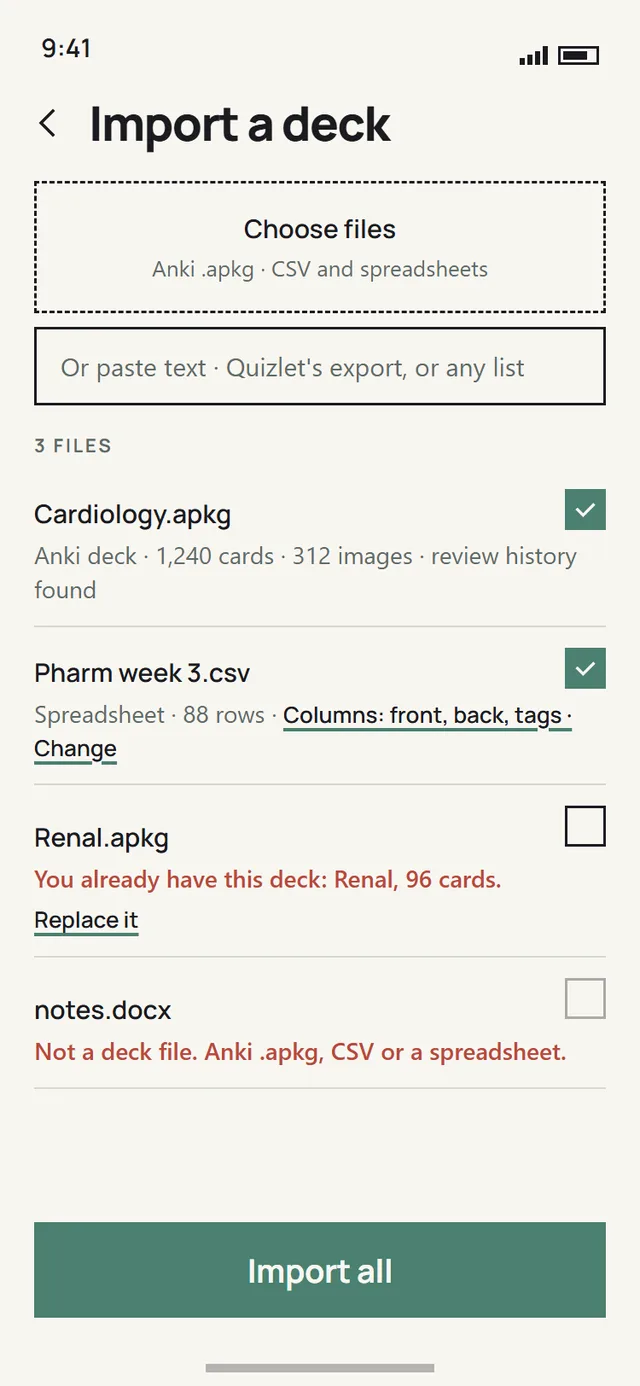
- Your decks, with their history. An Anki deck imports with its images, audio, tags and review history. Suspended cards arrive hidden. Nested decks become folders and tags, so nothing is lost, and a card you already have keeps its memory.
- Image occlusion. Numbered boxes on a picture, revealed one per card or all at once. Anki's own occlusion cards and the older add-on's masks both import.
- Shared decks. Share a deck by link, publish it, follow one and its updates arrive as a review step that never overwrites your edits.
- Export, free, always. An Anki file with media and history, a CSV, or Bunshu's own package, whose format is published.
What does Bunshu change?
- Nothing to set up. No settings to learn, no add-ons, no tutorial, and on your phone no account. Pick a deck, tap Start. Your first card is up within a minute.
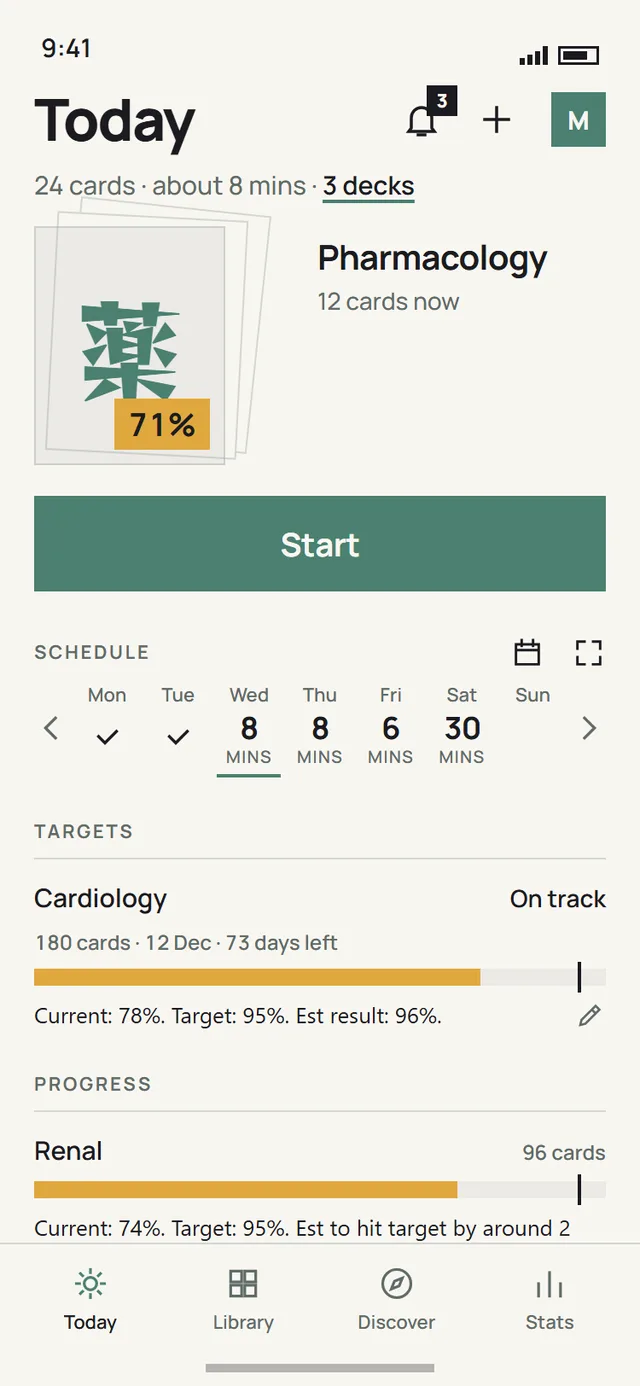
- A session sized to your minutes. Each session is the cards that fit the time you set. Miss a week and it's the same size: the cards that waited come first, most at risk first, and new cards wait their turn. You never open the app to 900 due.
- A target date. Give a deck your exam date and Bunshu says On track or Behind, with what would fix it in numbers. The day before is one full pass, so exam day has nothing left to cram.
- Read aloud, free. Every card reads in your phone's own voice, offline, hands-free if you like.
- Stats you can read in a line. How much you could recall today, the day you reach your target, and a calendar of study days with no streak to lose.
What's honestly different?
Four things Anki has that Bunshu doesn't, and what we put in writing instead.
- No add-ons. Bunshu is one finished app. What people often install add-ons for, reading cards aloud, a calendar of study days, richer stats, is built in. What add-ons supply beyond that isn't there.
- No card templates or custom styling. Five kinds of card, each one finished, and one look.
- No AnkiHub sync. Your AnKing deck imports whole, but the daily AnkiHub updates don't flow in. If those updates are what you need, Bunshu isn't for you yet.
- Not open source. In writing instead: export everything, any time, free, in formats other apps read; nothing is deleted if you stop paying or go quiet; your account can be deleted from inside the app; and studying is free on every plan, with no ads.
Bunshu, Anki and Quizlet, side by side
| Feature | Bunshu | Anki | Quizlet |
|---|---|---|---|
| One daily session sized to your time, with no backlog | Yes | Reviews build up | No |
| Works well with no settings to learn | Yes | Many settings | Yes |
| Study as a guest, with no account | Yes | Yes | Flashcards and Match only |
| Unlimited spaced repetition, free, with no ads | Yes | YesiPhone app US$24.99 | Learn mode capped on Freeand Free shows ads |
| Imports Anki decks with review history | Yes | Yes | No |
| Cards drafted from your notes, every one for your review | Yes | Through add-ons | AI features need Plus |
| Tells you how ready you'll be on your exam date | Yes | No | No |
Checked against each app's own pages on 5 October 2026, and the exam-date row on 31 October 2026. Anki and Quizlet are trademarks of their owners; Bunshu isn't affiliated with either.
Questions people ask
Can I import my Anki deck?
Yes. Decks import with their images, audio, tags and review history, suspended cards arrive hidden, and nested decks become folders and tags. A whole collection imports deck by deck.
Does Bunshu sync AnkiHub?
No. Your AnKing deck imports whole, but the daily AnkiHub updates don't flow in. A deck followed on Bunshu's shelf updates with a review step instead. If the daily update is what you need, Bunshu isn't for you yet.
Is Bunshu free?
Yes. Making cards, reviewing and every way of studying are free and unlimited on every plan, with no ads. Plus adds unlimited AI drafting, generated audio, deep Stats and more storage, for US$9.99 a month or US$59.99 a year.
Is Bunshu affiliated with Anki?
No. Anki is a trademark of its owners. Bunshu imports Anki's files and uses FSRS, the open-source model Anki also uses, and has no connection with Anki beyond that.
Sources
- Anki's own pages, read 5 October 2026: the desktop and Android apps are free; AnkiMobile is US$24.99 on the App Store. FSRS is open source under the MIT licence.
- Our research: 230,816 posts, comments and app reviews by people who use flashcard apps, September 2024 to September 2026, on Reddit, the App Store, Google Play and Hacker News; the three numbers are counts from it. Quotes are attributed as on bunshu.com.
- Bunshu's design, chapters 2, 4, 6, 9, 11 and 12: the first session, how a session is built, the target date, import and export, shared decks, and Stats.
- The Quizlet column: read in a browser on 5 October 2026, on a free account.