Guide
The forgetting curve, in plain words
The forgetting curve is the shape of memory left alone: a steep drop in the first hours, then a long, slow tail. Hermann Ebbinghaus drew it on himself in 1885, it was replicated in 2015, and it is what a spaced-repetition scheduler runs on. Each review starts a new curve, higher and flatter than the last, which is why the work falls over time.
In short
- Steep then flat. By Ebbinghaus's savings measure, about 58% was left after 20 minutes, 34% after a day and 21% after a month.
- The curve is not a sentence. A review resets it higher and flatter, and the gaps between reviews grow.
- Modern schedulers such as FSRS model the curve per card with three numbers: stability, difficulty and retrievability.
- Review when recall is about to fall to your target, 90% by default. Earlier adds little; later costs a lapse.
What is the forgetting curve?
It is a graph of how much of something you still have against the time since you learnt it, and it falls fast then slowly. Ebbinghaus measured it in the 1880s by learning lists of nonsense syllables and then timing how much faster he could relearn each list after a gap. The time saved is the memory left. By that measure he kept about 58% after 20 minutes, 44% after an hour, 36% after nine hours, 34% after a day, 28% after two days, 25% after six days and 21% after 31 days.
Murre and Dros repeated the experiment in 2015 with the same method: one subject, 70 hours of learning and relearning, the same gaps. The curve was replicated, with the same steep start and long tail. They also looked at which equation fits it best and found that a power function fitted about as well as the sum of exponentials their memory model predicts; and they noticed that savings after one day sat a little above the curve, a bump that may be connected with sleep, though they say that remains to be established.
Takeaway
What you learnt this morning is mostly gone by tomorrow if you leave it. What survives the first day fades slowly after that.
What does a review do to it?
It starts a new curve, higher and flatter than the one before. That is the whole mechanism of spaced repetition: each successful recall after a gap makes the memory last longer, so the next gap can be longer again. Cepeda and colleagues' review of 317 experiments in 2006 found that the gap producing the best retention grew with how long you needed to remember, and their 2008 study with over 1,350 people put it at about a fifth of the way to a test a few weeks off, falling to about a twentieth for a year.
The timing matters more than the count. Bjork and Bjork's theory of disuse, from 1992, holds that a retrieval made when the memory has started to fade adds more to its long-term strength than one made while it is fresh. The model Bunshu and Anki use puts a figure on it: by FSRS's arithmetic, as Bunshu's design states it, a card whose memory would last 196 days, reviewed five days after its last review, gets about 7% more durable; reviewed when it is due, it roughly triples.
How does a scheduler use it?
By keeping a forgetting curve for every card and reviewing the card when its curve is about to cross your target. FSRS, the open-source model Anki has shipped since 2023 and Bunshu uses, describes each card with three numbers.
- Stability is how long the memory lasts: the number of days until your chance of recalling the card falls to 90%. It grows with each successful review.
- Difficulty is how hard the card is to strengthen: a difficult card's stability grows more slowly per review.
- Retrievability is your chance of recalling the card right now, read off its curve from the days since the last review and its stability.
The model's parameters are fitted to real reviews. The public benchmark that tracks spaced-repetition algorithms runs on 9,999 Anki collections and about 350 million reviews, and on it FSRS-6 predicted recall better than Anki's older SM-2 scheduler, by log loss, for 99.6% of users. After a few hundred of your own reviews, the model is fitted to you.
What does it mean for your studying?
Three things. Review on time rather than early, since an early review lands on a curve that has barely dropped and adds little. Accept a target below 100%: at 90% you forget about one card in ten at review time, on purpose, because the reviews that would push it higher cost more than they return. And expect the work to fall: once a deck has reached its target, each card's gaps keep growing, so the same deck needs fewer reviews each month. In Bunshu's design, as an example and not a measurement, a finished 300-card deck drops from about 21 reviews a day to about 4, and a deck that has matured takes about a minute a week.
How does Bunshu use it?
For every card, Bunshu keeps the estimate of your chance of recalling it right now, and brings the card back when that chance is about to fall to your target. Remember it, and its memory lasts longer next time; forget it, and it comes back sooner. Current recall on a deck is that number across its cards today, and a deck with a date shows the same number projected to the date. Target recall is one slider, 90% by default, with what each stop costs in your own minutes. Nothing is ever shown early to fill time, and after a few hundred reviews the model fits itself to you, on every plan.
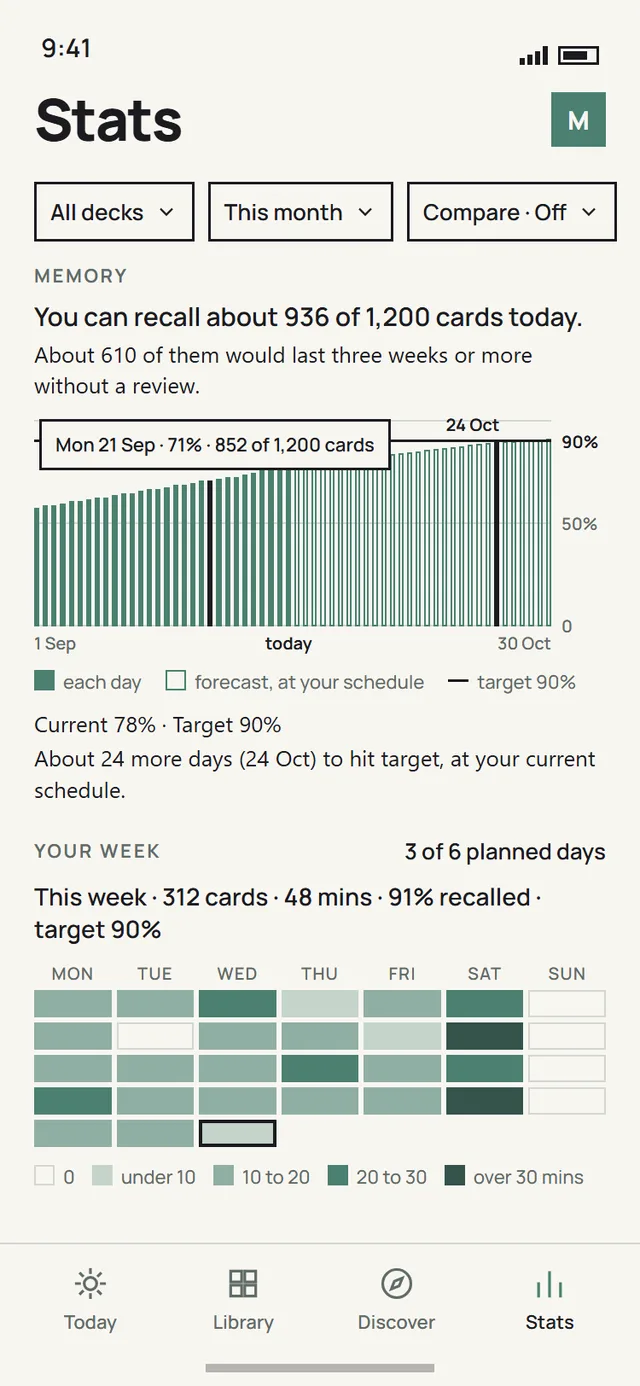
Bunshu isn't out yet; it's estimated to launch in early 2027.
Questions people ask
Is the forgetting curve exponential?
Roughly, and the exact function is still argued over. In the 2015 replication, a power function fitted the data about as well as a sum of exponentials. What matters for studying is the shape: steep at first, then flat.
Does sleep change the curve?
Possibly. The replication found savings after one day a little higher than the curve predicts, a bump the authors suggest may be connected with sleep, while saying it remains to be established. Nothing on this page rests on it.
What is a good target recall?
90% is the usual default: you forget about one card in ten at review time, on purpose, because the reviews that would push it higher cost more than they return. For an exam deck, 95% is worth it. In Bunshu's design, 95% costs about 1.6 times the reviews of 90%.
Why does my app show a percentage on a card?
That is retrievability: the model's estimate of your chance of recalling the card right now, read off its forgetting curve. When it is about to fall to your target, the card comes back.
In short
- Steep then flat: most of the loss is in the first day.
- A review starts a new, flatter curve; the gaps grow.
- Stability, difficulty, retrievability: the three numbers a scheduler keeps per card.
- Review on time, accept 90%, and watch the work fall.
Sources
- Ebbinghaus, H. (1885). Über das Gedächtnis; in English as Memory: a contribution to experimental psychology (1913). The savings figures are as reprinted in Murre and Dros (2015), Table 3.
- Murre, J. M. J., and Dros, J. (2015). Replication and analysis of Ebbinghaus' forgetting curve. PLOS ONE, 10(7), e0120644. Open access. Read 31 October 2026.
- Cepeda, N. J., Pashler, H., Vul, E., Wixted, J. T., and Rohrer, D. (2006). Distributed practice in verbal recall tasks: a review and quantitative synthesis. Psychological Bulletin, 132, 354 to 380. PubMed. Abstract read 31 October 2026.
- Cepeda, N. J., Vul, E., Rohrer, D., Wixted, J. T., and Pashler, H. (2008). Spacing effects in learning: a temporal ridgeline of optimal retention. Psychological Science, 19, 1095 to 1102. Open copy. Read 31 October 2026.
- Bjork, R. A., and Bjork, E. L. (1992). A new theory of disuse and an old theory of stimulus fluctuation. In A. Healy, S. Kosslyn and R. Shiffrin (eds), From learning processes to cognitive processes (the Estes festschrift), vol. 2, Erlbaum, 35 to 67. Summaries read 31 October 2026.
- FSRS, the open-source memory model: the ABC of FSRS (stability, difficulty, retrievability) and the algorithm. Read 31 October 2026. The 196-day example is the model's arithmetic as Bunshu's design states it.
- The spaced-repetition algorithm benchmark: expertium.github.io/Benchmark.html. Read 31 October 2026.
- Bunshu's design, chapter 5: how Bunshu decides when you see a card, the target recall and the worked figures.