Guide
Why you forget what you read, and how to keep it
You forget what you read because reading is recognition, not recall. Nothing was pulled out of memory, so nothing was strengthened, and the forgetting curve does the rest within a day. What keeps it is a question you answer from memory, written from the passage while it is in front of you, and answered again at growing gaps.
In short
- Most forgetting happens in the first day; the curve then flattens. Ebbinghaus measured it on himself and it was replicated in 2015.
- Reading again does not fix it. Rereading and highlighting are rated low utility by the research.
- Pulling an answer out of memory does. Testing beat rereading at every delay longer than a few minutes.
- Turn what you read into questions as you read, and answer them at growing gaps.
Why do I forget what I read?
Because memory for something met once drops fast and then levels off, and reading leaves a trace that feels stronger than it is. Hermann Ebbinghaus measured the drop on himself in 1885, learning lists of nonsense syllables and timing how much faster he could relearn them later. By that measure he kept about 58% of the saving after 20 minutes, 44% after an hour, 34% after a day, and 21% after a month. Steep in the first hours, then a long slow tail.
In 2015 Jaap Murre and Joeri Dros repeated the experiment with the same method: one subject, 70 hours of learning and relearning lists at gaps from 20 minutes to 31 days. The curve was replicated. They also found that savings after one day sat a little higher than the curve predicts, a bump they suggest may be connected with sleep, though they say that remains to be established.
Reading makes the drop worse to live with, because reading is recognition. The words are familiar as you go, so the material feels known, and nothing warns you that you could not reproduce it. Kornell's flashcard experiments show how unreliable that feeling is: 72% of people believed the massed study had worked better, when it had worked better for 10%.
Takeaway
If you only read it, expect to lose most of it by tomorrow. That is not a flaw in you; it is the shape of memory left alone.
Why doesn't rereading help?
Because it repeats the recognition rather than the recall. Roediger and Karpicke showed this in 2006: students read passages, then either reread them or tested themselves on them without feedback. Five minutes later, the rereaders scored higher. That is the trap; the immediate result favours rereading. At the longer delays the authors tested, the students who had tested themselves retained more, and the paper's conclusion is that testing is a powerful way of improving learning, not only of measuring it.
When Dunlosky and colleagues rated ten study techniques in 2013, rereading and highlighting, the two students use most, were rated low utility, because they do not reliably help. Practice testing and spaced practice were the two rated high. Highlighting marks a passage; it does not store it.
What keeps it?
Pulling the answer out of memory, more than once, with gaps that grow. Three findings set the dose.
- Recall, not recognition. Karpicke and Blunt showed in 2011 that retrieval practice produced more learning from science texts than concept mapping, including on questions that needed inference. Writing a question from a passage and answering it later is retrieval practice on your own reading.
- A few recalls, spaced. Rawson and Dunlosky's recommendation from 533 students: recall a thing correctly three times when you learn it, then relearn it three times at widely spaced intervals. The relearnings did the most for retention a month or more later, at a small cost in extra trials.
- Gaps that grow with the horizon. Cepeda and colleagues found in 2008, across more than 1,350 people, that the best gap between learning and reviewing scaled with how far away the test was: about a fifth of the way for a test a few weeks off. For something you want to keep for years, the gaps stretch to months.
How to read so it stays
Read a section, close it, and write one question you could not have answered before you read it, with its answer in your own words. Keep the question short enough to answer in a sentence; if it takes a paragraph, it is two questions. Mark the page or passage it came from, so you can check yourself later. Then let a scheduler bring the question back: tomorrow, in about a week, and at growing gaps after that. Each time, answer before you look.
Two things to resist. Do not write the card as a reread, with the answer in the question. And do not make cards for everything: one or two per section, for the things you would want to say to someone else about it, is what you will actually review.
How does Bunshu do this?
Hand Bunshu the PDF, the article, the slides or a photo of the page. It shows what it understood, drafts three cards for your OK, then every card points to the line it came from and a second model checks it before you do. In the viewer, highlight a passage and one action, Make a card, drafts a card from that passage alone. Your materials are kept for 14 days, every card keeps its Source, and each card comes back just before you would forget it. Typing your own cards is free and unlimited; the drafting is a Plus feature with three drafts free.
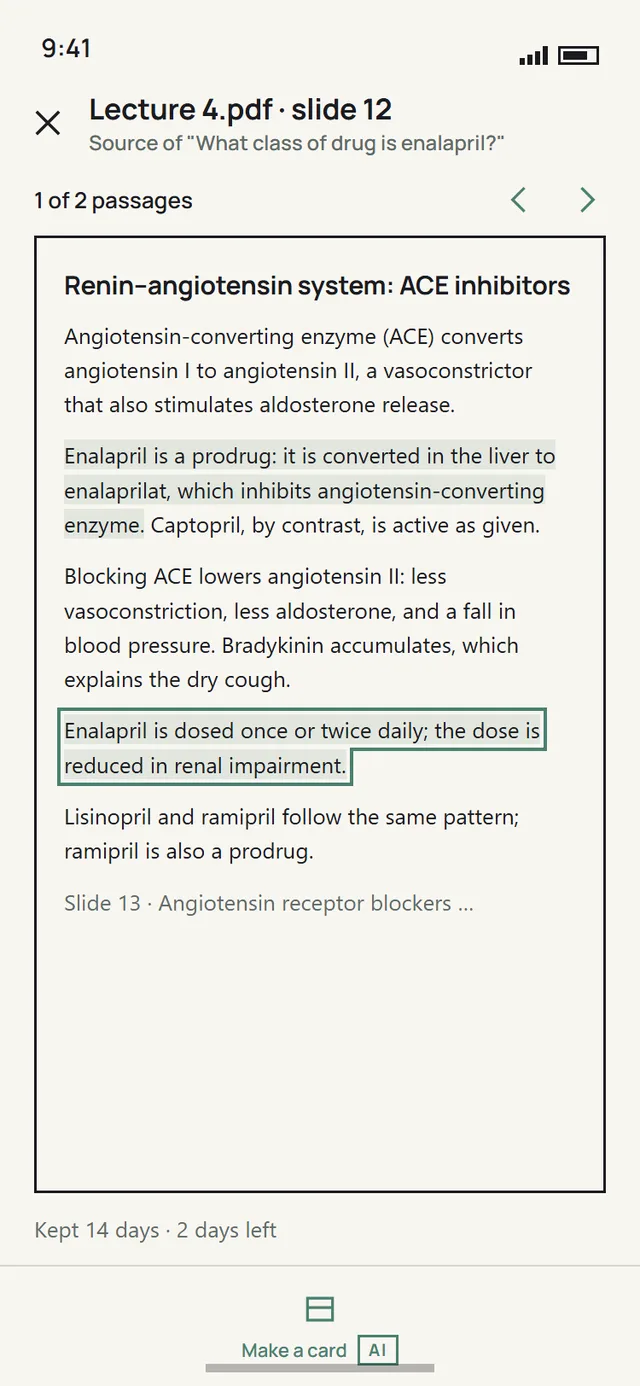
Bunshu isn't out yet; it's estimated to launch in early 2027.
Questions people ask
Is it normal to forget most of a book?
Yes. The forgetting curve is steep in the first day for anything you only read once. What you keep is what you used: the ideas you explained, applied, or pulled back out of memory. A book you want to keep needs a few questions written from it and answered later.
Does highlighting help at all?
It marks a passage; it does not store it. In the largest review of study techniques, highlighting was rated low utility. Highlight if it helps you find the passage again, then write a question from it, which is what does the storing.
How soon should I review what I read?
Within a day, then after about a week, then at growing gaps. The best gap grows with how long you want to keep the thing, so the first review comes soon and the later ones spread out.
Can I use AI to make the cards from my reading?
You can, if every card is checked against the text. In Bunshu each drafted card points to the line it came from and a second model checks it before you do, and typing your own cards is free and unlimited. The recall is still yours to do; only the typing is skipped.
In short
- Most of what you only read is gone by tomorrow; that is the curve, not you.
- Rereading and highlighting repeat the recognition; recall is what stores.
- One or two questions per section, answered from memory at growing gaps.
Sources
- Ebbinghaus, H. (1885). Über das Gedächtnis; in English as Memory: a contribution to experimental psychology (1913). The savings figures are as reprinted in Murre and Dros (2015), Table 3.
- Murre, J. M. J., and Dros, J. (2015). Replication and analysis of Ebbinghaus' forgetting curve. PLOS ONE, 10(7), e0120644. Open access. Read 31 October 2026.
- Roediger, H. L., and Karpicke, J. D. (2006). Test-enhanced learning: taking memory tests improves long-term retention. Psychological Science, 17, 249 to 255. PubMed. Abstract read 31 October 2026.
- Dunlosky, J., Rawson, K. A., Marsh, E. J., Nathan, M. J., and Willingham, D. T. (2013). Improving students' learning with effective learning techniques. Psychological Science in the Public Interest, 14, 4 to 58. SAGE. Abstract read 31 October 2026.
- Karpicke, J. D., and Blunt, J. R. (2011). Retrieval practice produces more learning than elaborative studying with concept mapping. Science, 331, 772 to 775. PubMed. Abstract read 31 October 2026.
- Rawson, K. A., and Dunlosky, J. (2011). The retrieval-practice schedules paper: how much practice is enough for durable and efficient learning. Journal of Experimental Psychology: General, 140, 283 to 302. PubMed. Abstract read 31 October 2026.
- Cepeda, N. J., Vul, E., Rohrer, D., Wixted, J. T., and Pashler, H. (2008). Spacing effects in learning: a temporal ridgeline of optimal retention. Psychological Science, 19, 1095 to 1102. Open copy. Read 31 October 2026.
- Kornell, N. (2009). Optimising learning using flashcards: spacing is more effective than cramming. Applied Cognitive Psychology, 23, 1297 to 1317. doi:10.1002/acp.1537. Abstract read 31 October 2026.
- Bunshu's design, chapters 5 and 10: the model, and drafting cards from your materials.