Quizlet alternative
A Quizlet alternative with real scheduling, free
Quizlet is the fastest way to start with flashcards, and millions of sets are a search away. What it does not do is schedule your reviews across sets and days by how well you remember, and its free plan now limits the study modes that come closest. Bunshu does the scheduling, keeps studying free in writing, and reads a Quizlet export. Here is the honest comparison.
In short
- Quizlet does well: nothing to set up, a huge library of sets, Flashcards and Match without an account, Learn and Test modes.
- What changed: on the free plan, Learn is limited to a number of rounds per set, Test is limited, the AI features need Plus, and the free plan shows ads.
- Bunshu: spaced repetition fitted to you, a session sized to your time, a target date, free to study with no ads, in writing.
- Missing in Bunshu: Quizlet's library of ready sets, Match and the games, and classes for teachers.
What does Quizlet do well?
It starts at once. Open any public set and the Flashcards and Match modes work without an account; Learn and Test need one. There is nothing to configure, which is why it is the first flashcard app most students meet. Its library of sets covers almost any course, and a set can be turned into a practice test in a tap.
What changed in it?
The free plan narrowed. Quizlet's help centre says Learn, the mode that comes nearest to a review schedule, is available in full to Plus subscribers, and free accounts can study it for a limited number of rounds per set; free accounts get one practice test per set; and the AI features, Magic Notes and Q-Chat among them, need Plus beyond limited previews. The free plan shows ads, which Plus removes. These are as read on Quizlet's own pages on 5 October and 31 October 2026; its pricing page refused a direct read today, so no prices are quoted here, and the limits may have moved since.
The deeper difference is not the plan. Learn adapts its rounds within one set towards a goal, but nothing in Quizlet keeps one daily queue across all your sets, sized to the time you have, that brings each card back just before you would forget it. That is the thing a spaced-repetition scheduler does, and it is what Bunshu is built around.
What does Bunshu do instead?
- Real scheduling. FSRS, the open-source memory model, brings each card back just before you would forget it, fitted to your own reviews after a few hundred of them, with nothing to tune.
- A session sized to your time. Each session is the cards that fit the minutes you set, across every deck. Miss a week and it is the same size.
- A target date. Give a deck your exam date and Bunshu says On track or Behind, with what would fix it in numbers.
- Free to study, in writing. Cards, reviews and every way of studying are free and unlimited on every plan, with no ads. Export is always free, and nothing is deleted if you stop paying.
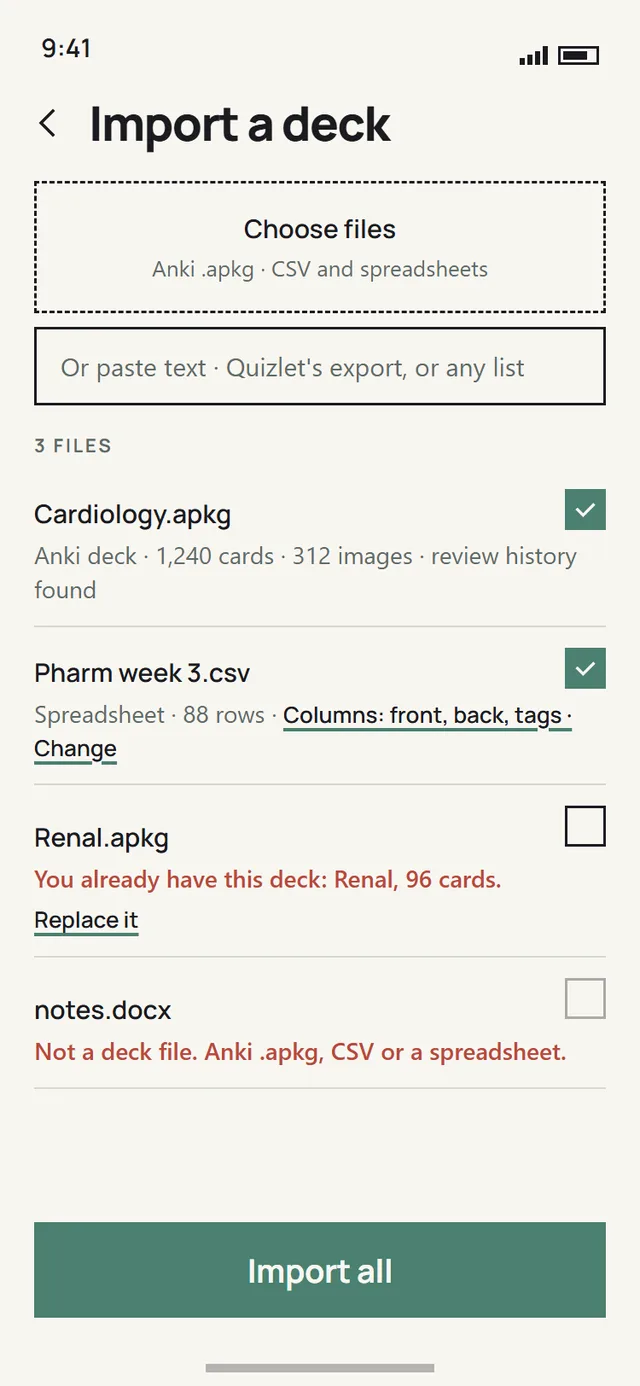
- Your Quizlet sets come across. Quizlet exports a set you made as text, from its website: open the set, choose Export, pick the layout and copy. Paste it into Bunshu's import box and the cards are made. Text only, since that is all Quizlet gives; images and study history do not come across.
What's honestly different?
- No library of ready sets at the size of Quizlet's. Bunshu has a shelf of shared decks and its own originals, and imports Anki decks, but Quizlet's library is far larger.
- No Match, no games. On purpose: Bunshu is calm, with no streaks and no feed, and studying is the session.
- No classes for teachers at launch.
- Not out yet. Bunshu is estimated to launch in early 2027, on iPhone, Android and the web.
Bunshu, Anki and Quizlet, side by side
| Feature | Bunshu | Anki | Quizlet |
|---|---|---|---|
| One daily session sized to your time, with no backlog | Yes | Reviews build up | No |
| Works well with no settings to learn | Yes | Many settings | Yes |
| Study as a guest, with no account | Yes | Yes | Flashcards and Match only |
| Unlimited spaced repetition, free, with no ads | Yes | YesiPhone app US$24.99 | Learn mode capped on Freeand Free shows ads |
| Imports Anki decks with review history | Yes | Yes | No |
| Cards drafted from your notes, every one for your review | Yes | Through add-ons | AI features need Plus |
| Tells you how ready you'll be on your exam date | Yes | No | No |
Checked against each app's own pages on 5 October 2026, and the exam-date row on 31 October 2026. Anki and Quizlet are trademarks of their owners; Bunshu isn't affiliated with either.
Questions people ask
Can I move my Quizlet sets to Bunshu?
Yes, for the sets you made. On Quizlet's website, open the set, choose Export, pick the layout and copy the text; paste it into Bunshu's import box and the cards are made. Quizlet exports text only, so images and study history don't come across.
Is Bunshu free the way Quizlet used to be?
Studying is free and unlimited on every plan, in writing, with no ads: cards, reviews and every way of studying. Plus sells unlimited AI drafting, generated audio, deep Stats and more storage, for US$9.99 a month or US$59.99 a year, and nothing you need to study is ever locked.
Does Bunshu have Match or games?
No, on purpose. Bunshu is built around spaced repetition: each card comes back just before you would forget it, in a session sized to your time. There are no games, no streaks and no feed.
Is Bunshu affiliated with Quizlet?
No. Quizlet is a trademark of its owner. Bunshu reads a Quizlet export and has no connection with Quizlet beyond that.
Sources
- Quizlet's help centre, read 31 October 2026 through search: Subscribing to Quizlet (Learn limited to a number of rounds per set on free accounts; one practice test per set; Plus removes the caps and the ads) and Exporting your sets (the set's creator only, on the website, Export then copy the text). The pricing page refused a direct read that day.
- The founder's browser, 5 October 2026, on a free account: Flashcards and Match without an account, Learn and Test with one; the AI features behind Plus beyond previews; ads on the free plan; Import takes pasted text only.
- Bunshu's design, chapters 9 and 14: import through the paste box, and the free core.
- Anki's column: as on the Anki page, read 5 October 2026.