Guide
Four weeks to an exam: a study plan that fits your days
Four weeks is enough, if you start today. Learn the material in the first two weeks, in short daily sessions. Review it with gaps that grow. Stop adding new cards two days before the exam, and spend the last day on the cards you still get wrong. That is the plan the spacing research supports, and it is the plan Bunshu builds when you give a deck your date.
In short
- Start today. Spacing needs days between reviews, so four weeks is room, not pressure.
- Test yourself instead of rereading. The two techniques the research rates highest are practice testing and spaced practice.
- Learn in the first half, review in the second. A card holds after a few successful recalls spread over weeks.
- No new cards in the last two days. The last day is one pass over what you still get wrong.
- Cramming works for tomorrow and loses to spacing for anything further away.
Is four weeks enough?
Yes. The gaps you are worried about are the method. Spaced repetition works because you review a card after you have started to forget it, and forgetting takes days. Four weeks gives every card room for several of those gaps. A weekend of cramming gives it none.
The cleanest test of this with flashcards is Nate Kornell's 2009 study. People learnt word pairs on a flashcard program, some as one big stack, so each card came round after a long gap, and some as four small stacks studied one after another. The big stack won for nine people in ten. The twist is what the learners believed: straight after the first session, most of them were sure the small stacks had worked better. Spacing feels worse while you are doing it. That feeling is not information.
How wide should the gaps be? The largest review of the question, by Cepeda and colleagues, found that the best gap grows with the distance to the test, and their follow-up put a rule of thumb on it. For a test a few weeks away, leave about a fifth of that time between learning a card and your first serious review of it. For four weeks, that is about a week.
Takeaway
Four weeks is a good horizon for spacing, not a short one. Start today and let the gaps grow.
How many cards a day?
Fewer new cards than you think, because every new card brings its reviews with it. A card you learn on day one comes back on day two or three, again about a week later, and again before the exam. By the third week most of your minutes go on reviews. That is why the plan puts the learning in the first half.
How many successful recalls does a card need? Rawson and Dunlosky tested it with students learning conceptual material and checked them months later. Their advice is simple to follow: recall each card correctly three times when you learn it, then meet it again on three later days, well spread out. A handful of extra recalls made a large difference to what was still there months on. In four weeks, that means learning a card properly in the first fortnight and getting it right about three more times before the date.
So the sum is: the cards you need, divided by the days in the first two weeks. If that number is more than your daily minutes can hold, you have three honest moves. Fewer cards, more minutes, or an earlier start next time.
What should the last week look like?
Reviews only, on time, and the last day as one pass over the cards you still get wrong. Three rules follow from the research.
- No new cards in the last two days. A card learnt the day before has had no gap, and a card with no gap is the one you forget in the exam hall.
- Test, don't reread. Dunlosky and colleagues reviewed ten common study techniques. Practice testing and spaced practice came out on top. Rereading and highlighting, the two students use most, came out at the bottom, because they do not reliably help. The night before is for recalling, not for reading your notes one more time.
- Review on time, not early. The memory model behind Anki and Bunshu, FSRS, puts it plainly: a review a few days early adds almost nothing to how long a card holds, and a review when the card is due roughly triples it. Going over cards you already know on the last night feels safe and does almost nothing. The night belongs to the cards you failed this week.
What goes wrong, and how to avoid it
We read a lot of posts and app reviews by students with an exam ahead, and the same four things went wrong over and over.
- The first Sunday goes on settings. "Spent my entire Sunday watching YouTube videos about optimal settings", from a flashcard user on Reddit, was one of the most upvoted lines we found. Take the defaults and start. The scheduling is good enough out of the box.
- Making cards replaces studying. "Making the flashcard deck took longer than learning the actual material. But it FELT productive and that's the trap." That is a flashcard user on Reddit, and it is the trap. Make short cards, in your own words, for the things you get wrong. Not for everything.
- The pile. Miss a few days and the reviews stack up, and the stack is what makes people quit. If it happens, turn new cards off until it clears. Everyone who cleared one says the same. The backlog guide has the steps.
- Trusting the feeling. Massed study feels better and works worse, as Kornell's learners showed. If a method feels easy, treat that as the warning sign.
How does Bunshu plan it?
Give a deck your exam date and Bunshu plans back from it. While the date is set, the deck's target recall goes to 95%, and a row on Today says On track or Behind, with the recall it expects on the day. If your sessions hold too little review time, Heads Up tells you what would fix it, in numbers: more review time, a later date, a lower target, fewer cards. The last new card arrives two days before the date. The day before is one full pass of the deck, so exam day has nothing left to cram. You decide; the row's word follows.
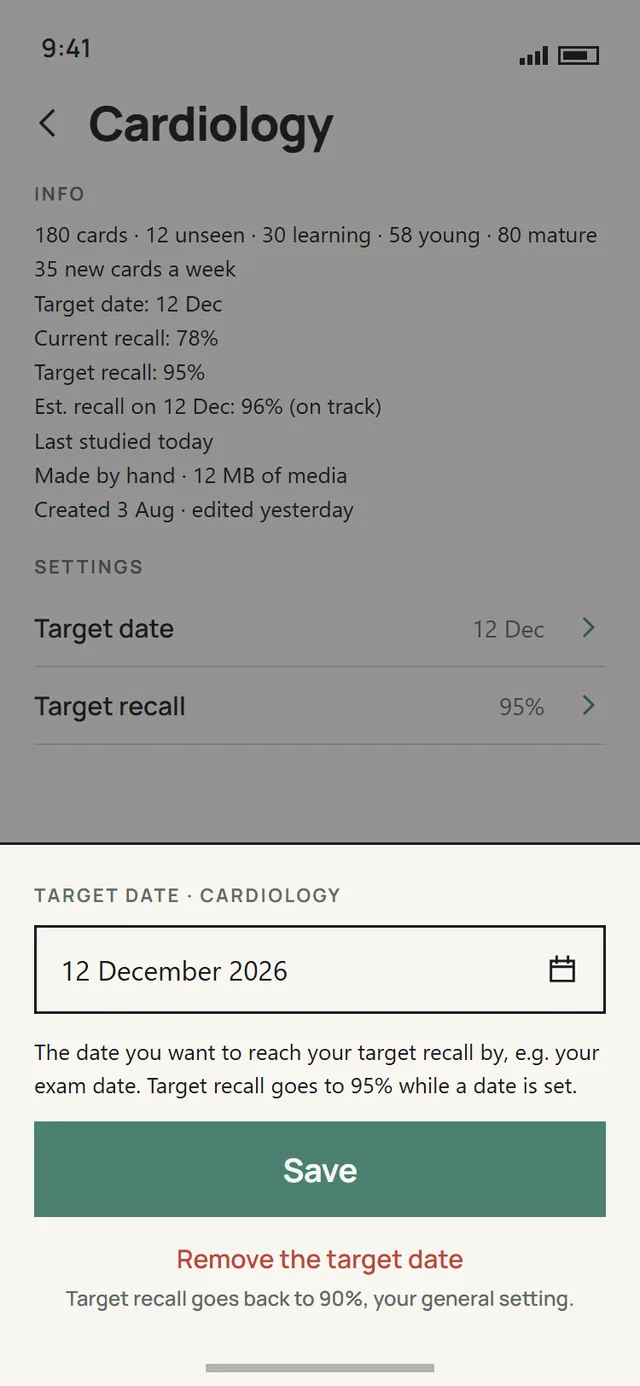
A worked example from the design, not a measurement. Mei puts 12 December on a 180-card deck on 1 November. Her sessions hold two hours a week and the plan needs about three hours forty minutes, so she makes her sessions 40 minutes and the bar goes. About 35 new cards a week arrive with their reviews, the last on 10 December. On 11 December she does one pass of about 25 minutes, with an estimated result of about 96% on the day. Bunshu isn't out yet; it's estimated to launch in early 2027. Studying in it is free on every plan.
Questions people ask
Is it too late with two weeks?
No. It is the same plan with shorter gaps. The best gap between learning and reviewing shrinks with the time you have, so with two weeks it is a few days rather than a week. Start today, keep your daily minutes, and stop new cards two days before.
Should I reread my notes the night before?
Test yourself instead. In the largest review of study techniques, rereading and highlighting came out at the bottom and practice testing at the top. The night before is for recalling what you still get wrong, not for reading everything again.
How many cards can I learn in four weeks?
It depends on your minutes a day, because every new card brings its reviews with it. As a worked example from Bunshu's design, not a measurement: about 35 new cards a week fitted beside other decks in 40 minutes a day, six days a week.
Does cramming ever work?
For tomorrow, yes. For a test a few weeks away, spaced study beat cramming the day before in Kornell's flashcard experiments, for nine people in ten.
In short
- Start today. The gaps are the method.
- Test yourself rather than reread.
- Learn in the first half, review in the second. Each card needs a few spaced recalls.
- No new cards in the last two days. The last day is a pass over what you still get wrong.
- Cramming wins for tomorrow and loses for the month.
Sources
- Kornell, N. (2009). Optimising learning using flashcards: spacing is more effective than cramming. Applied Cognitive Psychology, 23, 1297 to 1317. doi:10.1002/acp.1537. Abstract read 31 October 2026. Spacing won for 90% of the participants; after the first session 72% believed massed study had worked better.
- Cepeda, N. J., Pashler, H., Vul, E., Wixted, J. T., and Rohrer, D. (2006). Distributed practice in verbal recall tasks: a review and quantitative synthesis. Psychological Bulletin, 132, 354 to 380. PubMed. Abstract read 31 October 2026. 839 comparisons from 317 experiments: the best gap grows with the distance to the test.
- Cepeda, N. J., Vul, E., Rohrer, D., Wixted, J. T., and Pashler, H. (2008). Spacing effects in learning: a temporal ridgeline of optimal retention. Psychological Science, 19, 1095 to 1102. Open copy. Read 31 October 2026. Over 1,350 people, gaps up to three and a half months, tests up to a year later: about a fifth of the way to a test weeks away, about a twentieth for a test a year away.
- Rawson, K. A., and Dunlosky, J. (2011). The retrieval-practice schedules paper: how much practice is enough for durable and efficient learning. Journal of Experimental Psychology: General, 140, 283 to 302. PubMed. Abstract read 31 October 2026. 533 students, tested one to four months later: three correct recalls, then three spaced relearning sessions.
- Dunlosky, J., Rawson, K. A., Marsh, E. J., Nathan, M. J., and Willingham, D. T. (2013). Improving students' learning with effective learning techniques. Psychological Science in the Public Interest, 14, 4 to 58. SAGE. Abstract read 31 October 2026. Ten techniques; practice testing and spaced practice rated high utility, rereading and highlighting low.
- FSRS, the open-source memory model: the algorithm. The early-versus-on-time comparison is the model's arithmetic as Bunshu's design states it: a card whose memory would last 196 days, reviewed five days after its last review, gets about 7% more durable; reviewed when due, it roughly triples.
- Our research: 230,816 posts, comments and app reviews by people who use flashcard apps, September 2024 to September 2026, about 9,900 of them by students with an exam ahead. Quotes are attributed as on bunshu.com.
- Bunshu's design, chapters 4, 5 and 6: the session, the model, the target date and the worked example.