Guide
How to memorise a lot in a short time, and still have it next month
You can memorise a lot in a short time; the question is whether you still have it next month. Cramming wins the first test and loses the one after. The fastest way that lasts is short gaps that grow, recall instead of rereading, stopping when you have a thing rather than drilling past it, mixing the topics, and letting a little forgetting happen before each review.
In short
- Cramming works for tomorrow. For a month away, spaced practice beat it in every study we checked.
- Gaps that grow: a day or two, then a week, then longer, as far as your horizon allows.
- Recall, don't reread. Stop a card once you have it; extra drilling in the same sitting adds nothing later.
- Mix the topics. It feels slower and tests better.
- Reviews are where the time goes, so set the new cards a day from the reviews you can keep up.
Can you memorise a lot in a short time?
Yes, for tomorrow. An evening of drilling will get a stack of cards through a test the next morning. The problem is what happens afterwards, and that is the part the research measured.
Rohrer and Taylor tested it with maths in 2006. Students who spread the same practice problems across sessions retained more at a later test than those who did them in one block, while extra practice after mastery in a single session, what the paper calls overlearning, left later retention unchanged. Kornell found the same with flashcards in 2009: studying GRE word pairs in one large stack, so each card came round after a longer gap, beat studying four small stacks, and spacing beat cramming on the last day before the test, for 90% of the participants. The catch in both is that the massed version feels better. In Kornell's study, 72% of people believed massing had worked better after the first session.
Takeaway
Speed is not the enemy. The enemy is one sitting. Split the same hours across days and the memory lasts.
What is the fastest way that still lasts?
Short gaps that grow, recall instead of rereading, stopping at mastery, and mixing the topics. Each has its paper.
- Gaps that grow with your horizon. Cepeda and colleagues found in 2008, with over 1,350 people and tests up to a year later, that the best gap between learning and reviewing scaled with how far away the test was: about a fifth of the way to a test a few weeks off, about a twentieth for a year. So for next month, learn a card today, meet it again in a day or two, then after about a week, then before the date. Their 2006 review of 317 experiments found the same rule across the literature.
- Recall, not rereading. Pulling an answer out of memory is what builds the memory; reading it again mostly builds confidence. Dunlosky and colleagues rated practice testing and spaced practice the two most useful study techniques in 2013, and rereading and highlighting among the least. The active-recall guide has the detail.
- Stop at mastery, in the sitting. Rohrer and Taylor's overlearning result: once you have a thing right, doing more of it in the same session did nothing for the later test. The time is better spent on the next thing, or on tomorrow's review of this one.
- Mix the topics. Kornell and Bjork found in 2008 that people who studied painters' works mixed together recognised new paintings better than people who studied each painter's works grouped, though the grouped study felt more effective. When you have a lot to learn across topics, let them interleave rather than finishing one before the next.
How much can you learn a day?
As many new cards as you can review on time, which within a couple of weeks is where most of the time goes. A card learnt today comes back tomorrow or the day after, again in about a week, and again later, so each day's new cards add to every following day's reviews. Rawson and Dunlosky's dose from 2011 is three correct recalls when you learn a thing and three spaced relearnings after; multiply that by your cards and the reviews are the bulk of the work.
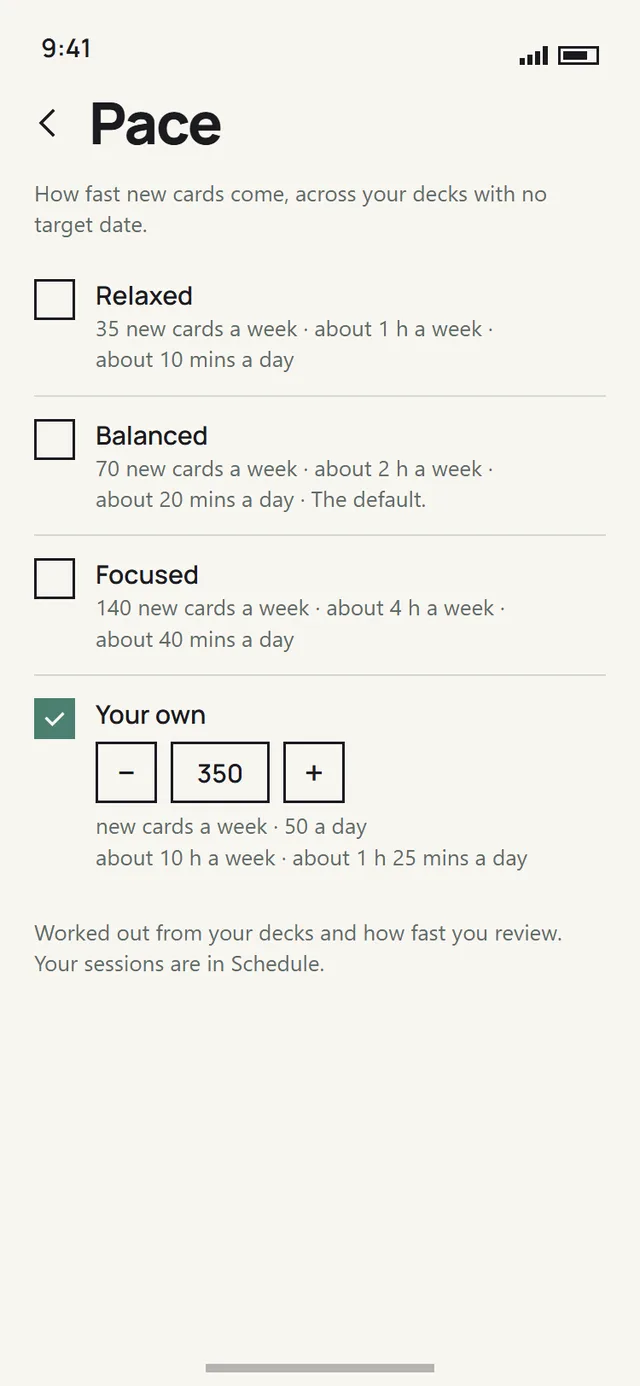
The honest arithmetic is: set the daily new cards from the review minutes you can keep every day, not from the cards you wish you had learnt. If the reviews land late, each one does less for the memory and you add more to catch up, which is the loop behind "doing nothing but flashcards for six hours a day". As an example from Bunshu's design, not a measurement: its Focused pace is 140 new cards a week at about four hours a week once a deck is under way, and its Balanced pace is 70 at about two hours.
Why does a little forgetting help?
Because a review does the most for a memory when the memory has started to fade. Bjork and Bjork's theory of disuse, from 1992, separates how well a thing is stored from how easy it is to retrieve right now, and holds that a retrieval made when retrieval is harder, because some forgetting has happened, adds more to storage than one made when the answer is fresh. That is why spacing works, and why a review done too early feels safe and does little.
The memory model Bunshu and Anki use, FSRS, puts numbers on it. By its arithmetic, as Bunshu's design states it, a card whose memory would last 196 days, reviewed five days after its last review, gets about 7% more durable; reviewed when it is due, it roughly triples. So the fastest schedule is not the one with the most reviews. It is the one where each review lands on time.
How does Bunshu handle a lot, fast?
Pace sets how fast new cards come, in your own numbers: Relaxed, Balanced, Focused, or a number of your own, each saying what it costs in cards a week, time a week and time a day, worked out from your decks and how fast you review. The session is the cards that fit the minutes you set, due cards first, most at risk first; when the reviews overflow a session, new cards pause by themselves until they fit again, so the loop above cannot start. The model brings each card back just before you would forget it and never shows one early to fill time, and when your own answers slow down it asks once whether you would like a break.
Bunshu isn't out yet; it's estimated to launch in early 2027.
Questions people ask
Is 100 new cards a day possible?
Possible, if you can also do the reviews they generate on time, which within a couple of weeks is most of the work. Set the number from the reviews you can keep up, not from the cards you wish you had learnt. If the reviews land late, each does less and the pile grows.
Does mixing topics slow me down?
It feels slower and tests better. In Kornell and Bjork's experiments, mixing artists' paintings beat grouping them for recognising new paintings, even though the grouped study felt more effective.
What if I only need it for the exam?
Then give the deck the date and plan back from it; the last day is one pass. But an exam a month away is already far enough that spacing beats cramming, so the method is the same. Only the gaps change.
Should I keep going once I know the cards?
Not in the same sitting. Rohrer and Taylor found extra practice after mastery in one session left later retention unchanged, while spacing the same practice across sessions raised it. Stop when you have it, and come back after a gap.
In short
- Cramming wins tomorrow and loses next month.
- Gaps that grow; recall, not rereading; stop at mastery; mix the topics.
- Set new cards from the reviews you can keep up.
- A review on time does far more than one done early.
Sources
- Rohrer, D., and Taylor, K. (2006). The effects of overlearning and distributed practise on the retention of mathematics knowledge. Applied Cognitive Psychology, 20, 1209 to 1224. Open listing. Read 31 October 2026.
- Kornell, N. (2009). Optimising learning using flashcards: spacing is more effective than cramming. Applied Cognitive Psychology, 23, 1297 to 1317. doi:10.1002/acp.1537. Abstract read 31 October 2026.
- Cepeda, N. J., Vul, E., Rohrer, D., Wixted, J. T., and Pashler, H. (2008). Spacing effects in learning: a temporal ridgeline of optimal retention. Psychological Science, 19, 1095 to 1102. Open copy. Read 31 October 2026.
- Cepeda, N. J., Pashler, H., Vul, E., Wixted, J. T., and Rohrer, D. (2006). Distributed practice in verbal recall tasks: a review and quantitative synthesis. Psychological Bulletin, 132, 354 to 380. PubMed. Abstract read 31 October 2026.
- Dunlosky, J., Rawson, K. A., Marsh, E. J., Nathan, M. J., and Willingham, D. T. (2013). Improving students' learning with effective learning techniques. Psychological Science in the Public Interest, 14, 4 to 58. SAGE. Abstract read 31 October 2026.
- Kornell, N., and Bjork, R. A. (2008). Learning concepts and categories: is spacing the enemy of induction? Psychological Science, 19, 585 to 592. SAGE. Abstract read 31 October 2026.
- Rawson, K. A., and Dunlosky, J. (2011). The retrieval-practice schedules paper: how much practice is enough for durable and efficient learning. Journal of Experimental Psychology: General, 140, 283 to 302. PubMed. Abstract read 31 October 2026.
- Bjork, R. A., and Bjork, E. L. (1992). A new theory of disuse and an old theory of stimulus fluctuation. In A. Healy, S. Kosslyn and R. Shiffrin (eds), From learning processes to cognitive processes (the Estes festschrift), vol. 2, Erlbaum, 35 to 67. Summaries read 31 October 2026.
- FSRS, the open-source memory model: the algorithm. The 196-day example is the model's arithmetic as Bunshu's design states it.
- Bunshu's design, chapters 3, 4 and 5: the session, the pace and the model.