Guide
Remember it for life: what the science says you need
You can keep a thing for decades, and the research on people who did says what it took. Not more hours. Meetings with the material weeks to months apart, continued past the point where you already knew it. A memory that survives its first few years tends to stay, and the gaps are what get it there.
In short
- Memory for school Spanish fell for three to six years, then held for decades (Bahrick 1984, 733 people).
- Eight years on, words relearnt at thirty-day gaps were recalled 2.5 times as often as words relearnt the same day (Bahrick and Phelps 1987).
- Over nine years, 13 sessions at 56-day gaps matched 26 sessions at 14-day gaps (Bahrick and colleagues 1993).
- Most of the long-term gain came from the sessions after the words were already known.
- A scheduler keeps this going per card, and a matured deck costs about a minute a week.
Can you really remember something for life?
Yes, and the clearest evidence is Harry Bahrick's study of people who had learnt Spanish at school up to fifty years earlier. In 1984 he tested 733 of them on vocabulary, grammar and reading, and asked about their courses, their grades and their use of the language since. Memory fell steeply for the first three to six years. Then it stopped falling and stayed level for up to thirty years, before a final decline late in life. Bahrick called the level stretch permastore: a large portion of what had been learnt was still there after fifty years.
Two details matter. The share that reached permastore depended on how much had been learnt, on the grades, and on whether the test asked for recall or recognition. And rehearsal in the decades between had no significant effect for most people. What survived the first few years survived on its own. The work is at the start, and the question is what kind of work gets a memory over that line.
Takeaway
Forgetting is front-loaded. A memory that makes it past its first few years tends to be yours for good.
What decides which memories last?
The gaps between the times you learnt it. In 1979 Bahrick had had students learn and relearn fifty English-Spanish word pairs in sessions held the same day, a day apart, or thirty days apart. In 1987, with Elizabeth Phelps, he found thirty-five of them and tested them again, eight years after their last session.
The words relearnt thirty days apart were recalled 15% of the time. The words relearnt a day apart, 8%. The words relearnt in one sitting, 6%. People never trained scored 1%. The thirty-day gap had made a word 2.5 times as likely to be recalled eight years later, with the same number of sessions. Recognition told the same story more gently: 83%, 80% and 71%.
Two honest notes. Recall was low overall, 9%, because eight years with no practice loses most of anything; the finding is the ratio, not the level. And the words that lasted best had taken one or two showings to learn, so a hard word needs the same gaps plus more meetings.
How far apart should the meetings be?
Weeks to months, and longer than feels safe. The same family ran the longest controlled study of this in 1993: four people, the authors themselves, each learnt 300 word pairs in French or German over nine years. Each set of fifty words was relearnt 13 or 26 times, at gaps of 14, 28 or 56 days, and tested one to five years after the last session. Four people is a small study, and they say so, but no one else has run one this long.
Over the five years, the words relearnt at 14-day gaps were recalled 43% of the time after 13 sessions and 56% after 26. At 28-day gaps, 50% and 68%. At 56-day gaps, 57% and 76%. So thirteen sessions at 56 days gave about the same retention as twenty-six at 14 days: the same result for half the work, by spacing alone. The cost was small and early: the longer gaps slowed learning slightly, and the 14-day words were the best known at the end of training. Within the first year the curves crossed, and the 56-day words stayed ahead.
The right gap depends on how long you want to keep the thing: in Cepeda and colleagues' 2008 study of more than 1,350 people, the best gap was about a fifth of the time until the test for a test weeks away, and about a twentieth for a year away. For life, that means months, where the Bahrick numbers sit.
Takeaway
Longer gaps cost a little at the start and pay back for years. For life, the gaps are months.
How many times do you have to meet it?
More times than it takes to know it. In the nine-year study, most words no longer needed showing by the seventh session: the person recalled them on the test that opened each session, so the later sessions were mostly retrieval. Those later sessions are where the long-term gain came from. Eight years after seven sessions at thirty-day gaps, recall in the 1987 study was 15%. Five years after thirteen and twenty-six sessions at 28-day gaps, it was 40% and 54%, and the extra sessions helped even with retrieval at the end of training held constant.
The spacing and the number of sessions worked independently, for easy words and hard ones alike. Two levers, and they add: meet the thing again after you know it, and let the meetings drift apart. Stopping as soon as you can recall it is what makes a memory short-lived.
What does this look like in a week?
Light, and lighter over time, if a scheduler is doing the spacing. The figures below are from Bunshu's design, not measured results, and are an example of the shape.
Say you finish learning a 300-card deck at the default target of 90% recall. While the cards are young the deck asks for about 21 reviews a day; as each memory lasts longer its next review moves out, and a few months after the last new card the deck asks for about 4. When nine cards in ten have a memory lasting three weeks or more, the design marks the deck Matured, and keeping it costs about a minute a week inside your ordinary sessions. Nothing is ever completely mastered: stop reviewing and recall fades, and a deck left alone for about four months comes back into your sessions by itself, faded cards first.
The sessions after you know the cards are the cheap ones, and the ones that make it permanent.
How does Bunshu do this?
Every card has its own estimate of how long its memory lasts, kept by FSRS, the open-source model Anki has shipped since 2023, fitted to your own reviews. A card comes back just before that estimate says you would forget it, so the gaps grow on their own, from days to weeks to months, and a card is never shown early to fill time. Memory, in Stats, shows how much of each deck you would recall today and the day you reach your target. A matured deck is marked, and keeps being reviewed at the model's own low rate.
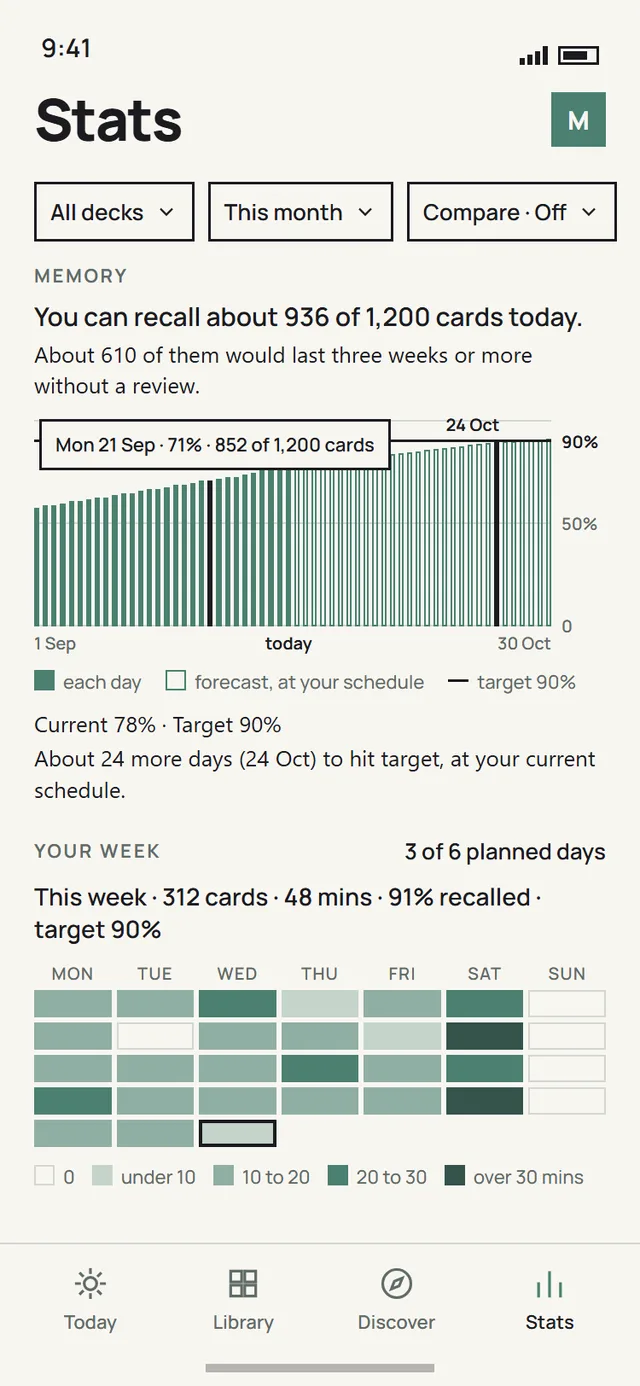
Bunshu isn't out yet; it's estimated to launch in early 2027. Studying in it is free on every plan.
Questions people ask
Do I have to keep reviewing for ever?
Less and less, but never nothing. In Bahrick's 1984 study the Spanish that survived its first few years then held for decades with little rehearsal, but only the share learnt well and spread out survived. In a scheduler the gaps keep growing, so a matured deck takes about a minute a week in Bunshu's design.
Is rereading my notes once a year enough?
The long studies measured recall, not rereading: each session began with a test, and a word was shown only when the test failed. A yearly look at your notes is recognition, which fades fast. A yearly recall of the cards you had started to forget is closer to what worked.
Does this work for things other than vocabulary?
Bahrick's 1984 sample was tested on grammar and reading too, and the spacing meta-analysis by Cepeda and colleagues pooled 839 results across many kinds of material. The pattern held.
What if I stop for a year?
Some of it goes, and what was spaced goes slowest. Eight years with no practice still left words learnt at thirty-day gaps 2.5 times as likely to be recalled as words learnt in one day. In Bunshu the cards that faded come back first, and the session stays the size you set.
In short
- What survives its first few years tends to stay.
- Gaps of weeks to months between meetings decide what survives.
- Keep meeting it after you know it; those are the cheap sessions, and the ones that count.
- A scheduler grows the gaps for you, and a matured deck costs about a minute a week.
Sources
- Bahrick, H. P. (1984). Semantic memory content in permastore: fifty years of memory for Spanish learned in school. Journal of Experimental Psychology: General, 113, 1 to 29. PubMed. Abstract read 31 October 2026.
- Bahrick, H. P., and Phelps, E. (1987). Retention of Spanish vocabulary over 8 years. Journal of Experimental Psychology: Learning, Memory, and Cognition, 13, 344 to 349. doi:10.1037/0278-7393.13.2.344. Full text read 31 October 2026.
- Bahrick, H. P., Bahrick, L. E., Bahrick, A. S., and Bahrick, P. E. (1993). Maintenance of foreign language vocabulary and the spacing effect. Psychological Science, 4, 316 to 321. doi:10.1111/j.1467-9280.1993.tb00571.x. Full text read 31 October 2026.
- Cepeda, N. J., Vul, E., Rohrer, D., Wixted, J. T., and Pashler, H. (2008). Spacing effects in learning: a temporal ridgeline of optimal retention. Psychological Science, 19, 1095 to 1102. eScholarship. Abstract read 31 October 2026.
- Cepeda, N. J., Pashler, H., Vul, E., Wixted, J. T., and Rohrer, D. (2006). Distributed practice in verbal recall tasks: a review and quantitative synthesis. Psychological Bulletin, 132, 354 to 380. PubMed. Abstract read 31 October 2026.
- Bunshu's design, chapters 5 and 12: the model, target recall, matured decks, and Memory in Stats. The example's figures are the design's, not measurements.