Guide
Flashcards from your notes, and the mistakes that waste them
Most of the time lost to making flashcards goes into the wrong cards: a paragraph on one face, a list on another, cards about things not yet understood, and cards set aside the moment they feel known. The research says what a card should hold and who decides when it is done. The habit: understand the page, make small cards from it, one point each, and let the schedule decide which you still need.
In short
- Making the deck can take longer than learning the material, and it feels productive. That is the trap, in the students' own words.
- One point a card: simple items are easier to remember and easier to schedule (Wozniak 1999).
- Understand first, avoid sets and lists, hide one term in a sentence, keep a source on every card.
- Do not drop the cards you think you know: students allowed to drop flashcards learnt slightly less (Kornell and Bjork 2008).
- A drafted card is worth the line it came from. Check it before it is saved.
Why does making flashcards take longer than studying?
Because the cards are made as copies of the notes, and a copy is not a question. Among the students with an exam ahead whose posts we read, making cards was the third complaint. "I spend more time making Anki cards than studying. Is this normal?" And, with 529 upvotes on r/studytips: "Making the flashcard deck took longer than learning the actual material. But it FELT productive and that's the trap."
The trap has a mechanism. Dunlosky and colleagues' 2013 review of ten study techniques rated rereading and highlighting low in usefulness and practice testing high. A card with a paragraph on its back is rereading in a smaller box: you flip it, recognise the text, and feel it was known. A card you can answer from the front alone is a test, and the test does the work.
Takeaway
A card pays for itself in its reviews. One nobody can answer from the front alone never does.
What should one card hold?
One point, in as few words as answer it. Piotr Wozniak, who wrote SuperMemo, set out twenty rules for making cards in 1999. His opening line: "The speed of learning will depend on the way you formulate the material." The rule above the others is the minimum information principle. "By definition, simple material is easy to remember", and "Repetitions of simple items are easier to schedule." "If you split the complex item into sub-items, each can be repeated at its own pace saving your time."
Two forms of card do most of this. The cloze, in his words, "is a sentence with its parts missing and replaced by three dots": keep the sentence and hide the term that is the point. And a picture with a part hidden, since "A graphic representation of information is usually far less volatile." Keep the source too, so a card can be checked later.
An example, in the design's own words: the notes say enalapril is an ACE inhibitor, that it lowers blood pressure, and that its known side effect is a dry cough. That is three cards, not one, and the one you keep forgetting comes back sooner without dragging the other two with it.
Which cards waste the time?
Five kinds, by Wozniak's rules.
- Cards about things you do not yet understand. "Trying to learn things you do not understand may seem like an utmost waste of time." Read the page until it makes sense, then make the cards.
- Sets and lists. "You should avoid such items whenever possible due to the high cost of retaining memories based on sets", and "Avoid enumerations wherever you can." A list becomes a run of cards, each asking what comes next.
- Look-alikes. "Interference is probably the single greatest cause of forgetting in collections of an experienced user of SuperMemo." A word of context on the front tells two cards apart.
- Skipping the basics. "Do not neglect the basics." The obvious card holds the harder ones up.
- Cards with no link to you. "One of the most effective ways of enhancing memories is to provide them with a link to your personal life." An example of your own is worth a line in the notes.
Takeaway
Fewer words, one point, a source, and nothing you do not understand yet.
Should you drop the cards you already know?
No, because the feeling of knowing is a poor judge. Nate Kornell and Robert Bjork tested the habit in 2008 in four experiments, a habit "adopted almost universally by students": setting aside the flashcards they think they know. It has a logic, since the time goes to the cards left. But "being allowed to drop flashcards had small but consistently negative effects on learning." It "rests on two shaky foundations: students' metacognitive monitoring and the value they assign to further study."
The year before, they had put the condition plainly: "Good study decisions rest on accurate monitoring of ongoing learning, a realistic mental model of how learning happens, and appropriate use of study strategies." Kornell's 2009 flashcard experiments show how far off the monitoring runs: spacing beat massing for 90% of the people in them, and 72% believed the opposite. A card that feels known is often about to be forgotten; a scheduler can tell which. The same paper found one large stack beat four small ones, since one stack spaces each card out: mini-decks studied one at a time are cramming.
Takeaway
Delete a card because it is wrong or a duplicate, never because it feels easy.
Should you let AI make the cards?
Only if you check each card against the line it came from, and the people we read are right to be wary. "AI slop is an instant turn-off." "Unpopular opinion: you shouldn't use AI to create flashcards." The belief beneath both is sound: you learn more from cards you write yourself, because working out what the point is, is the learning.
What a drafter can take is the typing, under the rules above: one point a card, short answers, a source on every card, no card you do not understand. The question for any tool that drafts cards is whether it shows where each card came from; if not, you are reviewing text nobody checked. "I've always disliked how my notes lived in a different place than my active-recall content," one learner wrote; a card that opens its own page in your notes answers that too.
How does Bunshu do this?
Typing cards is free and unlimited: Basic, Basic + reversed, cloze, image occlusion and, on Plus, a vocabulary card, each with Notes and a Source, and Add many for pasting a page. Add with AI reads your notes, slides, a PDF, a photo or a recording, shows what it understood, and lets you choose the size: in the design, Essentials is about a third of the points, Balanced about six in ten, Thorough every point once. It drafts three cards first for you to check. Every card holds one key point, its Source must exist in the material (no passage, no card), and a second model checks it: one point, unambiguous, supported, answerable from the front alone, never a yes-or-no question. The draft opens in the editor with an "AI" chip on every card, each Source a tap to its line, and nothing is live until you Save. Three drafts are free, unlimited on Plus within fair use.
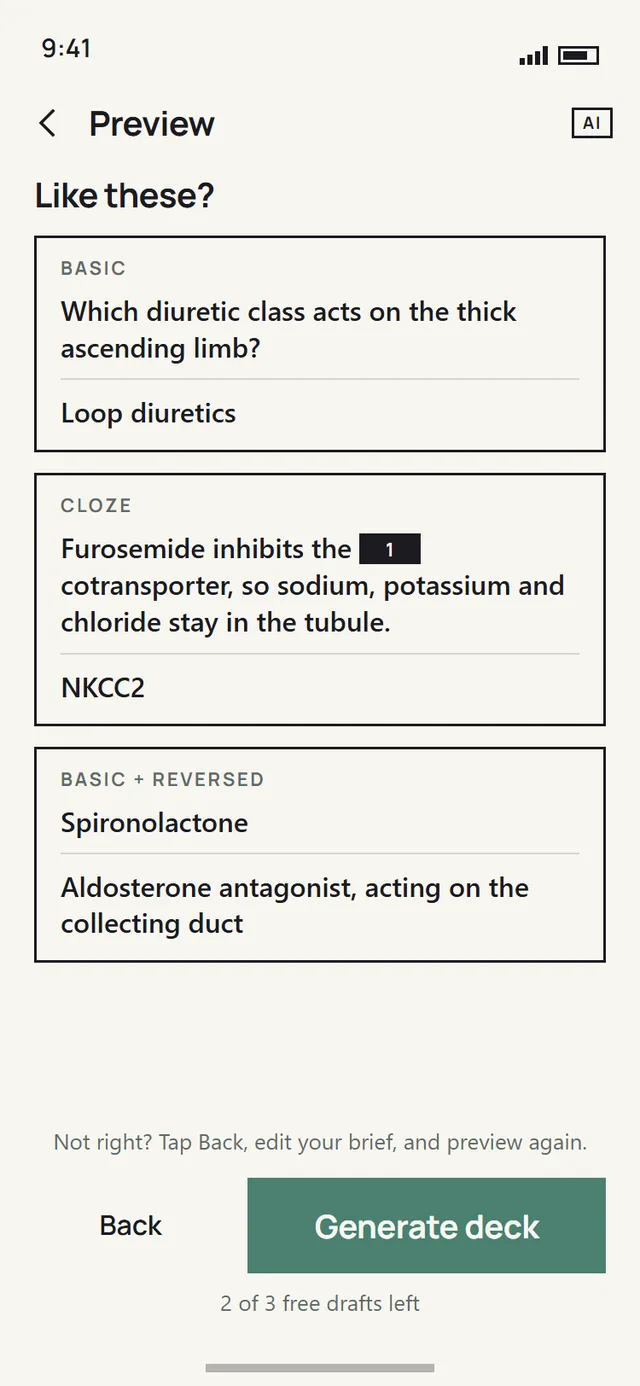
Bunshu isn't out yet; it's estimated to launch in early 2027. Studying in it is free on every plan.
Questions people ask
How many flashcards should I make from one lecture?
One for each point you would need to answer from memory: fewer than the lecture's sentences, more than its headings. In Bunshu's design, as an example, a drafted deck offers three sizes: about a third of the points, about six in ten, or every point once.
Is it better to make my own flashcards or use a shared deck?
Making them is part of the learning, and they match your course. A shared deck saves the evenings and arrives with its author's choices and errors. Both are reviewed the same way.
Should I put a whole definition on one card?
No. Hide the term inside the definition as a cloze, or ask a question whose answer is one phrase. A definition with four parts is four cards, each repeated at its own pace.
When should I delete a card?
When it is wrong, a duplicate, or about something you no longer need. Not when it feels easy: students who dropped the cards they thought they knew learnt slightly less.
In short
- A card is a question you answer from the front alone, not a copy of the notes.
- One point a card, a source on each, nothing you do not yet understand.
- Lists become runs of cards; look-alikes get a word of context.
- Keep the easy cards. The schedule spaces them out for you.
- A drafted card is checked against the line it came from, or it is not saved.
Sources
- Wozniak, P. (1999). Effective learning: Twenty rules of formulating knowledge. super-memory.com. Read 1 November 2026.
- Kornell, N., and Bjork, R. A. (2008). Optimising self-regulated study: the benefits and costs of dropping flashcards. Memory, 16, 125 to 136. doi:10.1080/09658210701763899. Abstract read 1 November 2026.
- Kornell, N., and Bjork, R. A. (2007). The promise and perils of self-regulated study. Psychonomic Bulletin and Review, 14, 219 to 224. doi:10.3758/BF03194055. Abstract read 1 November 2026.
- Kornell, N. (2009). Optimising learning using flashcards: spacing is more effective than cramming. Applied Cognitive Psychology, 23, 1297 to 1317. doi:10.1002/acp.1537. Abstract read 31 October 2026.
- Dunlosky, J., Rawson, K. A., Marsh, E. J., Nathan, M. J., and Willingham, D. T. (2013). Improving students' learning with effective learning techniques. Psychological Science in the Public Interest, 14, 4 to 58. SAGE. Abstract read 31 October 2026.
- Our research: 230,816 posts, comments and app reviews by people who use flashcard apps, September 2024 to September 2026, about 9,900 of them by students with an exam ahead. Quotes are attributed as on bunshu.com.
- Bunshu's design, chapters 9 and 10: the editor and drafting with AI. The sizes are the design's, not measurements.