Guide
Med school flashcards without six hours a day
Six hours of Anki a day is not what the studies found helped. In the studies that followed medical students, higher Step 1 scores went with steady, daily use, and the return on volume was about one point for every 1,700 extra cards. The hours come down when a card is never shown before it is due, a session is sized to the minutes you have, and a missed day stays a day.
In short
- Steady use is what the studies tie to Step 1: daily users 238 against 233.5 (Wothe 2023); students who kept reviewing every earlier block scored about ten points above those who did so sometimes (Lu 2021).
- Volume alone buys little: about one point for every 1,700 extra unique cards (Deng 2015).
- None of the eleven studies in the 2026 review randomised anyone, and the review says its findings should not be read as causal.
- The hours go into cards shown early, new cards faster than their reviews allow, and the pile after a missed day.
- A shorter day: a session the size you set, the cards most at risk first, and a deck with a date planned from the date.
Does six hours of Anki a day score higher?
Not in the studies that measured it, and the hours are the loudest complaint we read. Of the 230,816 posts, comments and app reviews we studied, 49,532 were by medical, dental, nursing and pharmacy students. "It's getting really old doing nothing but Anki for 6 hours a day." "Burnout after 1.5 hours of Anki. How to avoid?" And the post that spoke for the rest: "Will I remember all of this? I'll have to find out when I do my 800 reviews tomorrow."
The one study that counted cards against scores found a small return. In 2015 Deng, Gluckstein and Larsen surveyed 72 students at one US medical school after Step 1; the Anki users had seen 5,086 unique cards on average. In their model, every extra 1,700 unique cards went with about one more point, and practice questions about one point per 445. Second-year honours and the MCAT each counted for more, and test anxiety took nearly two points off. The authors call the study exploratory: one school, self-reported numbers.
Takeaway
Volume is the expensive way to a point. 1,700 cards is weeks of evenings for one mark.
What goes with higher scores, then?
Showing up, by the three studies that looked. In 2021 Lu, Farhat and Beck Dallaghan compared 201 students at one school: Anki users averaged 241.1 on Step 1 against 235.5, and inside the users the gap followed consistency. Those who reviewed all their earlier blocks "most of the time" averaged 246.9 and "always" 246.7, against 236.3 for "sometimes": about ten points for the habit, not the app. In 2023 Wothe and colleagues surveyed 165 students at another: the 56% who did their reviews daily had a median Step 1 of 238 against 233.5, and no difference on Step 2. Most of them introduced fewer than 150 new cards a day.
A 2026 systematic review by Frappa and colleagues pulled the field together: eleven studies, 1,135 students, none randomised. Three, the two above and Deng's, showed a consistent association between regular use and Step 1. Course exams were mixed: at one school, first-years who took up the app scored six to seven points higher after adjusting for the MCAT, though they had arrived with higher MCAT scores; at three others the difference was nil. The reviewers are plain: "students were not randomly assigned to Anki use", and "these findings should not be interpreted as causal." Stronger or more organised students may simply be the ones who pick the app.
Wothe's study also measured wellbeing: daily users slept the same seven hours and showed no difference in burnout, stress or leisure time. Its conclusion: there "may be some benefit", but the app "is not crucial to achieving academic outcomes and promoting wellbeing".
Takeaway
The studies tie scores to doing the reviews every day, not to the hours in the day. Steady beats heavy.
Where do the six hours go?
Into three things, and the students name all three.
- New cards faster than their reviews allow. "NO WAY you can do 200-300 new cards per day, plus all your reviews, if you're being honest with the 'again' button." Every new card is a promise of reviews for months.
- Cards shown before they are due. By the FSRS model's arithmetic, in Bunshu's design, a card whose memory lasts 196 days, reviewed 5 days after its last review, gets about 7% longer; reviewed on time, it roughly triples. Reviewing ahead to clear tomorrow buys almost nothing; the forgetting curve guide has the model.
- The pile after a missed day. The reviews that waited land on top of the day's own, and the week it takes to clear is what turns a habit into a grind. Their own advice: "Protect your energy: 6 steady days a week beat 7 burnt-out ones", and "Anki works best as a targeted tool, not a grind."
Takeaway
Fewer new cards a day, no card early, and a missed day that stays a day.
What does a shorter day look like?
In Bunshu's design, as an example and not a measurement, the pace sets how many new cards a week come across your undated decks and prints its cost: Balanced, the default, is 70 new cards a week at about twenty minutes a day once a deck is under way; Focused is 140 at about forty. A deck with a date is different: its target recall rises to 95%, about 1.6 times the reviews of the default 90%, it introduces its cards at the rate the date needs, Heads Up says in minutes a week when your sessions hold too little and what would close the gap, and the day before the exam is one full pass.
"One consistent pass of Anki is enough, no need to finish every subdeck" was the other advice we read most, and the design agrees. A session is the cards that fit its minutes, most at risk first across every deck, so twenty minutes buys the twenty that matter most.
Takeaway
Set the minutes, give the exam deck its date, and let the order of the cards do the triage.
How does Bunshu do this?
The session is the size you set: the cards that have reached their day, most at risk first, then new cards at your pace. Miss four days and it is the same size; the cards that waited come first and new cards pause until they fit, while a deck with a date keeps its plan's rate and Heads Up says what the days cost. A card is never shown early. When your answers slow, it asks once whether you would like a break. Your Anki deck imports whole, with images, tags and review history, suspended cards hidden; it does not follow AnkiHub's updates. Every card reads aloud in the phone's own voice, free and offline, with the volume keys on Android or a clicker to rate on a walk. There is no streak.
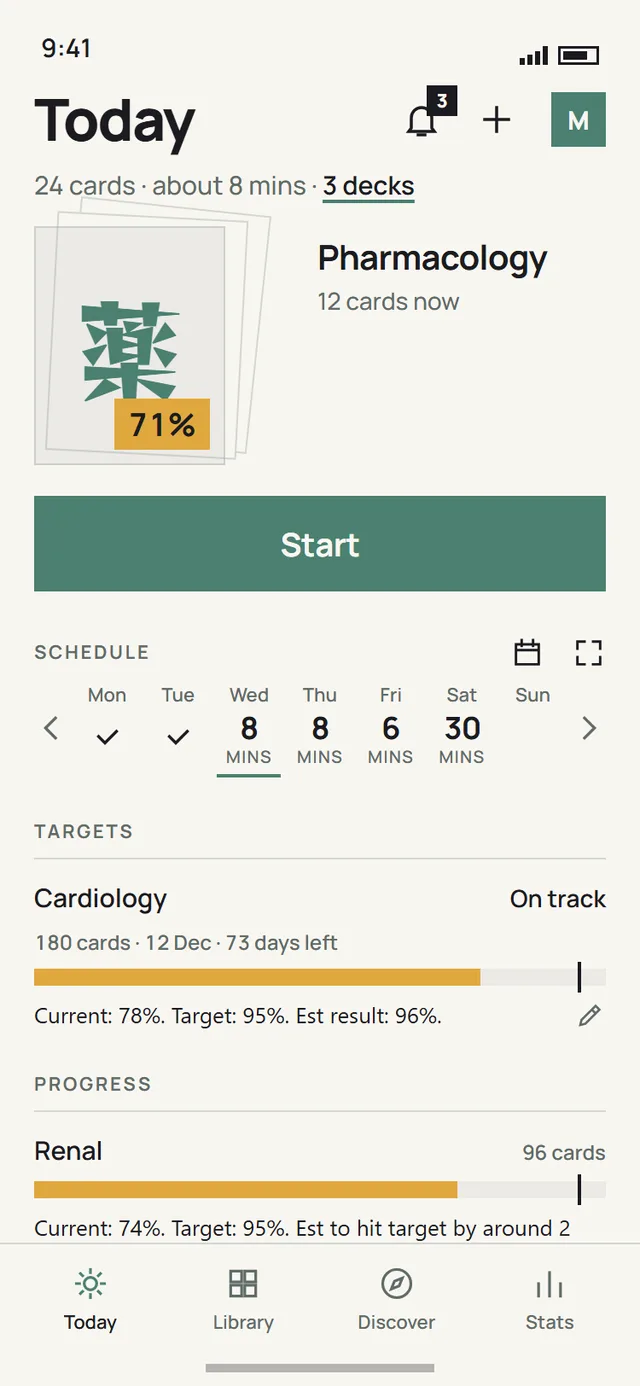
Bunshu isn't out yet; it's estimated to launch in early 2027. Studying in it is free on every plan.
Questions people ask
Should I do 200 new cards a day?
The daily users in Wothe's study mostly introduced fewer than 150 a day, and the studies tie scores to steadiness, not to new cards. In Bunshu the pace is yours to set, and a dated deck introduces cards at the rate its date needs. What no setting shrinks is the reviews that follow each new card for months.
Is a missed day the end of it?
No. There is no streak. The next session is its usual size, the cards that waited come first, and for a deck with a date Heads Up says what the day cost in minutes and what would make it up.
Does Anki itself raise Step 1 scores?
An association, not a cause. The 2026 review counted eleven studies, none randomised: a consistent link with Step 1 in three, mixed results on course exams, and no difference on Step 2 in the one study that checked. Its own words: the findings should not be interpreted as causal.
Can I bring my AnKing deck?
Yes, whole: the cards, images, tags and review history, with suspended cards arriving hidden, so the schedule carries on. Bunshu does not sync AnkiHub's updates. If the daily update is what you need, it is not for you yet.
In short
- The studies tie Step 1 to daily use, not to hours.
- Volume returned about one point per 1,700 cards; the habit of reviewing every block, about ten.
- None of it is causal, and the review says so.
- The hours go into early reviews, too many new cards, and the pile after a miss.
- A session the size you set, the most-at-risk cards first, a dated deck planned from its date.
Sources
- Deng, F., Gluckstein, J. A., and Larsen, D. P. (2015). Student-directed retrieval practice is a predictor of medical licensing examination performance. Perspectives on Medical Education, 4, 308 to 313. doi:10.1007/s40037-015-0220-x. Full text read 1 November 2026.
- Lu, M., Farhat, J. H., and Beck Dallaghan, G. L. (2021). Enhanced learning and retention of medical knowledge using the mobile flash card application Anki. Medical Science Educator, 31, 1975 to 1981. doi:10.1007/s40670-021-01386-9. Full text read 1 November 2026.
- Wothe, J. K., and colleagues (2023). Academic and wellness outcomes associated with use of Anki spaced repetition software in medical school. Journal of Medical Education and Curricular Development, 10. doi:10.1177/23821205231173289. Full text read 1 November 2026.
- Gilbert, M. M., and colleagues (2023). A cohort study assessing the impact of Anki as a spaced repetition tool on academic performance in medical school. Medical Science Educator, 33, 955 to 962. doi:10.1007/s40670-023-01826-8. Full text read 1 November 2026.
- Frappa, N., Chernov, D., Dillon, M., and Alben, M. G. (2026). Anki use and academic performance in medical education: a systematic review of evidence and learning theory. Medical Science Educator, 36, 1015 to 1025. doi:10.1007/s40670-026-02643-5. Full text read 1 November 2026.
- Our research: 230,816 posts, comments and app reviews by people who use flashcard apps, September 2024 to September 2026, 49,532 of them by medical, dental, nursing and pharmacy students. Quotes are attributed as on bunshu.com.
- Bunshu's design, chapters 3, 4, 5, 6 and 9: the session, the paces, the model, the target date and the import. The figures are the design's, not measurements.