Guide
Why new words vanish, and the one habit that keeps them
A new word is mostly gone within a day unless you meet it again. The research says how many meetings a word takes, when they should come, and what each should hold. The habit that follows is short: ten minutes most days, the words you had started to forget first, and new words only when they fit.
In short
- A day after learning, about a third of the original effort was still saved in Ebbinghaus's figures.
- Ten meetings with a word in context produced sizeable gains, and full knowledge takes more (Webb 2007).
- Spread the meetings out: eight years on, words relearnt at thirty-day gaps were recalled 2.5 times as often as words relearnt in a day (Bahrick and Phelps 1987).
- A card with the sentence and the sound does more per meeting than a word alone.
- The habit: a short session most days, the forgotten words first, and a missed week that is not a debt.
Why do new words vanish so fast?
Because the forgetting curve is steepest in the first day, and a word met once in a lesson is on the steep part. Ebbinghaus measured this on himself in the 1880s, and Murre and Dros's 2015 replication found the same shape: a day after learning, relearning took about two thirds of the original effort, and after that the loss slowed. By the weekend, a word met once on Monday reads like a word you have never seen.
That is the experience behind the line we read most often from language learners: "I'm not retaining a lot of the cards." They were not learning badly. They were meeting each word once, or many times in one sitting, which the curve treats as once. The forgetting curve, in plain words has the figures.
Takeaway
A word met once is not learnt, whatever it felt like in the lesson. The question is how many more times, and when.
How many times do you need to meet a word?
About ten, for a word to be usefully yours, and more for everything a word is. Stuart Webb tested this in 2007 with 121 Japanese students learning English. Using made-up words in real text, he had the students meet each one once, three, seven or ten times. Ten tests then measured the parts of knowing a word: its spelling, its grammar, the words it goes with, its meaning and form. Every increase in meetings produced larger gains in at least one part. His conclusion: "If learners encounter unknown words ten times in context, sizeable learning gains may occur. However, to develop full knowledge of a word more than ten repetitions may be needed."
Paul Nation's review of the research, in Learning Vocabulary in Another Language, finds no single number: it depends on the learner, the word and how it is met. In the studies he gathers, most learners needed five to seven meetings to learn a word from a paired list and a few needed more than twenty, while learning a word from reading alone took around sixteen. Plan for ten, and let the hard words take what they take.
When should the meetings come?
Spread out, with the gaps growing. Ten meetings on Monday are not ten meetings. In the meta-analysis by Cepeda and colleagues in 2006, which pooled 839 results from 317 experiments, spacing the meetings out beat massing them, and the best gap grew with how long the learner needed to keep the material.
For words you want to keep, the strongest evidence is from 1987, when Bahrick and Phelps tested thirty-five people eight years after they had learnt fifty Spanish words in sessions a day, thirty days or no time apart. Recall was 15% for the thirty-day words, 8% for the one-day words and 6% for the same-day words: the thirty-day gap had made a word 2.5 times as likely to survive eight years. Long gaps cost a little while learning and pay back for years; Remember it for life has the nine-year study that followed.
Takeaway
The same ten meetings spread over months keep a word; crammed into a week they barely do.
What makes a word card stick?
The sentence and the sound. Webb's ten tests make the point: knowing a word is knowing its meaning, its spelling, its grammar and the company it keeps, and a card with only the word and a translation meets one of those. We read 230,816 posts, comments and app reviews by people who use flashcard apps, 50,624 of them by language learners, and three things came up about the card itself.
- A sentence. "Cards with only isolated words are harder to remember." Sentence mining came up in 2,763 texts. A word in a sentence carries its grammar and company, so one meeting covers more.
- The sound. "You need to have earphones in and a deck with TTS enabled. I can easily do 200 cards on a 30 min walk." Hearing a word is a meeting you can have with your eyes elsewhere.
- Both directions. Recognising a word when you read it and producing it when you speak are different skills, and a card tests the direction it asks.
What is the one habit?
A short session most days, in which the words you had started to forget come first and new words come only when they fit. No one can plan meetings months apart by hand for hundreds of words, so a scheduler plans them, and your job is to turn up for the ten minutes it hands you.
The people who had kept the habit for years said where the ten minutes went: "Nowadays I usually do my reviews on the bus on my way to work." A slot, not a streak. And they said what broke it: "My Anki reviews have compounded into a debt I'll be servicing until I die." The debt forms when a missed week becomes a pile to clear before anything new. The advice everyone gave, "I would turn off new cards until the review pile goes down," is the habit as a repair, and a session sized by your minutes rather than the pile makes the repair automatic.
In Bunshu's design, as an example, the Relaxed pace introduces about 35 new words a week at about ten minutes a day with their reviews, and Balanced about 70 at about twenty. Those are the design's figures, not measurements. Choose by the minutes you will actually do.
How does Bunshu do this?
The vocabulary card takes the word, or the meaning, and fills the rest: the reading, a spoken clip, an example sentence with its own clip, and a picture where one fits, for you to check before you save. Each card can be one direction or both. Twenty vocabulary cards are free, then it is a Plus feature; the Basic + reversed card does the plain two-direction job for free, and Read aloud reads every card in your phone's own voice, free, offline and hands-free. FSRS, the open-source scheduler, brings each word back just before you would forget it; the session is the words that fit the minutes you set, and after a missed week the forgotten words come first while new ones wait.
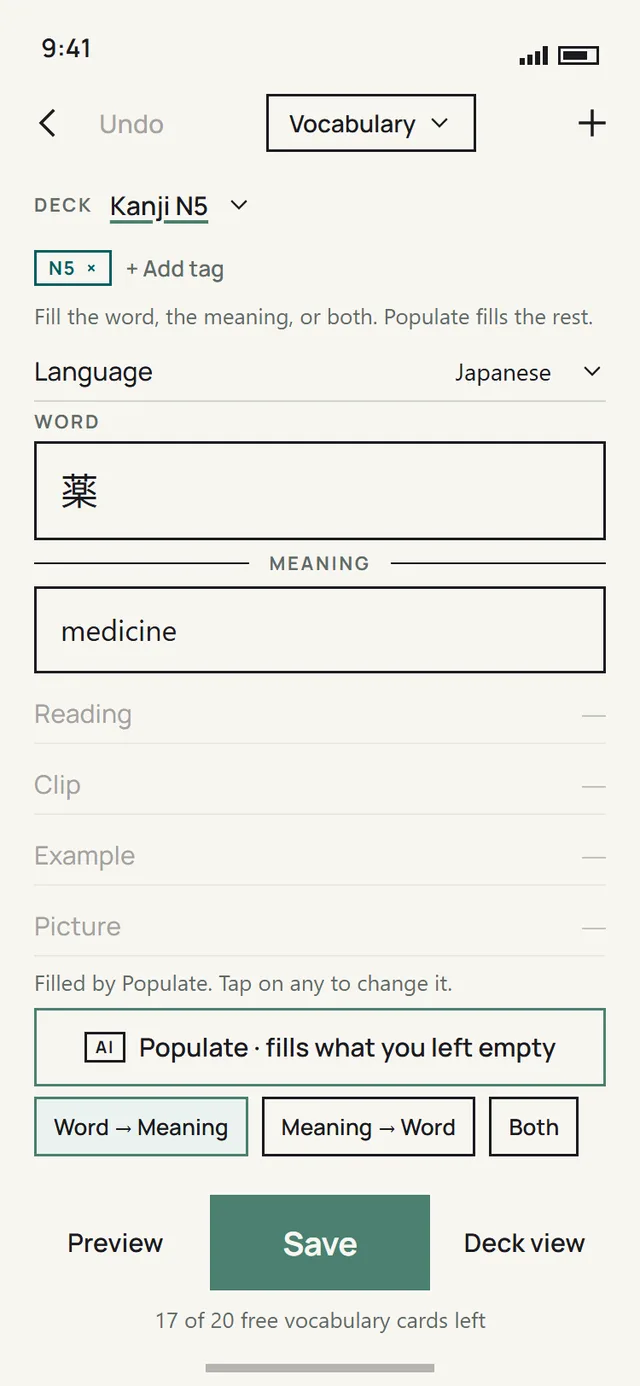
Bunshu isn't out yet; it's estimated to launch in early 2027. Studying in it is free on every plan.
Questions people ask
How many new words a day should I learn?
Fewer than you think, met more often. The research counts meetings per word, not words per day. In Bunshu's design the Relaxed pace is about 35 new words a week, about ten minutes a day with their reviews, and Balanced about 70. Pick the one whose minutes you will actually do.
Should I learn words in sentences or on their own?
In sentences, and hear them. Webb's study met the words in real text, and the learners we read said isolated words are the hardest kind of card. A card with the word, a sentence and the sound covers more of what knowing a word means.
Word to meaning, or meaning to word?
Both, as two cards with their own memories. Recognising a word when you read it and producing it when you speak are different skills, and a card tests only the direction it asks. Bunshu's vocabulary card and its Basic + reversed card make both at once.
I missed three weeks. Do I start again?
No. Spaced words are the ones that survive a gap: eight years on, words learnt at thirty-day gaps were still recalled 2.5 times as often as words learnt in a day. Review the words you had started to forget first, and add new ones only when they fit. In Bunshu that order is the default.
In short
- A word met once is on the steep part of the curve and mostly gone within a day.
- Plan for about ten meetings, spread over months, not one week.
- Put the sentence and the sound on the card, and test both directions.
- Ten minutes most days, the forgotten words first, and a missed week that is only a week.
Sources
- Webb, S. (2007). The effects of repetition on vocabulary knowledge. Applied Linguistics, 28, 46 to 65. doi:10.1093/applin/aml048. Abstract read 31 October 2026.
- Nation, I. S. P. (2001). Learning Vocabulary in Another Language. Cambridge University Press. The chapter on repetition, through summaries in later papers read 31 October 2026; the book itself not read.
- Bahrick, H. P., and Phelps, E. (1987). Retention of Spanish vocabulary over 8 years. Journal of Experimental Psychology: Learning, Memory, and Cognition, 13, 344 to 349. doi:10.1037/0278-7393.13.2.344. Full text read 31 October 2026.
- Cepeda, N. J., Pashler, H., Vul, E., Wixted, J. T., and Rohrer, D. (2006). Distributed practice in verbal recall tasks: a review and quantitative synthesis. Psychological Bulletin, 132, 354 to 380. PubMed. Abstract read 31 October 2026.
- Murre, J. M. J., and Dros, J. (2015). Replication and analysis of Ebbinghaus' forgetting curve. PLOS ONE, 10(7), e0120644. doi:10.1371/journal.pone.0120644. Full text read 31 October 2026.
- Our research: 230,816 posts, comments and app reviews by people who use flashcard apps, September 2024 to September 2026, 50,624 of them by language learners. Quotes are attributed as on bunshu.com.
- Bunshu's design, chapters 4, 5, 9 and 15: the paces, the model, the vocabulary card and Read aloud. The example's figures are the design's, not measurements.